



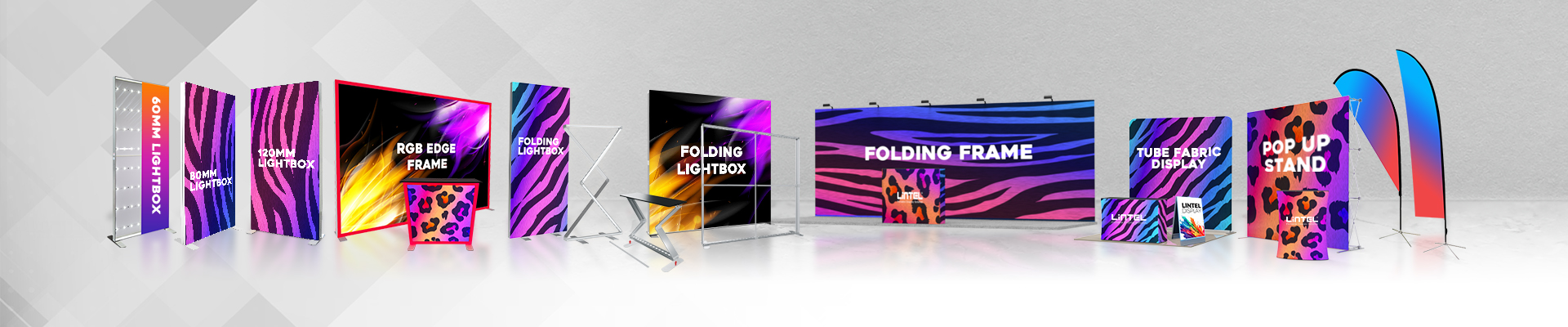
How to Choose a Fabric Lightbox: 4 Things to Consider Before Your Next Project
 Aug 21, 2026|
 View:189
Choosing the right fabric lightbox requires more than comparing frame sizes or prices.
A retail installation may prioritize a slim profile and clean integration, while a trade show booth may require freestanding stability, double-sided visibility, fast assembly, compact packing and repeat use.
Before specifying a system, evaluate four areas:
Location and mounting
Lighting configuration
SEG graphic quality
Setup, packing and reuse
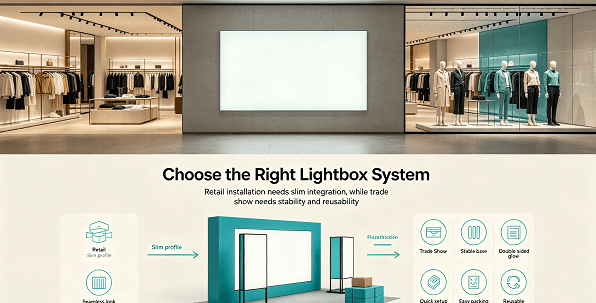
1. Match the Lightbox to the Space
Start with the installation environment.
Before production, confirm:
Available width and height
Viewing direction
Number of open booth sides
Electrical access
Venue height restrictions
Furniture or product display positions
The nominal booth size alone does not determine the correct frame dimensions.
Freestanding or Suspended?
A freestanding light box works well as:
A trade show backwall
A retail promotional display
A product-area divider
A reception backdrop
For freestanding systems, frame stability, base design and overall height should be evaluated together.
A suspended light box is useful when long-distance visibility is required without occupying floor space.
Typical applications include:
Large exhibition booths
Island booths
Retail atriums
High-ceiling interiors
For suspended displays, confirm venue-specific requirements for rigging, height, structural load and electrical routing before production.
2. Choose the Right LED Lighting Configuration
Most illuminated fabric displays use either edge lighting or direct backlighting.
Edge-Lit Lightbox
An edge-lit LED lightbox positions LED strips around the inside perimeter of the frame.
It is commonly used for:
Slim retail displays
Wall-mounted graphics
Compact illuminated signage
Its main advantage is reduced frame depth.
For larger displays, however, LED optics, frame depth and graphic diffusion must be carefully matched to avoid uneven brightness.
Direct Backlit Lightbox
A direct-backlit system positions LED modules behind the graphic.
It is commonly used for:
Large exhibition backwalls
Freestanding displays
High-impact retail graphics
Larger illuminated surfaces
Direct backlighting normally requires a deeper profile, but it can provide strong and uniform illumination when properly engineered.
| Consideration | Edge-Lit | Direct Backlit |
|---|---|---|
| LED position | Frame perimeter | Behind graphic |
| Frame depth | Shallower | Deeper |
| Typical use | Retail, wall-mounted graphics | Exhibition backwalls, larger displays |
| Main priority | Optical efficiency | LED spacing and diffusion |
Single-Sided or Double-Sided?
A single-sided light box is suitable when the display sits against a wall or is mainly viewed from one direction.
A double-sided light box is better suited to:
Exhibition aisles
Open retail spaces
Island booths
Freestanding dividers
It allows the same floor footprint to deliver visibility from both directions.
For long-term commercial use, also check LED uniformity, power supply quality, replaceability and operating-life rating.
Lintel uses applicable LED configurations rated for 50,000+ operating hours. Actual service life depends on operating conditions and maintenance.
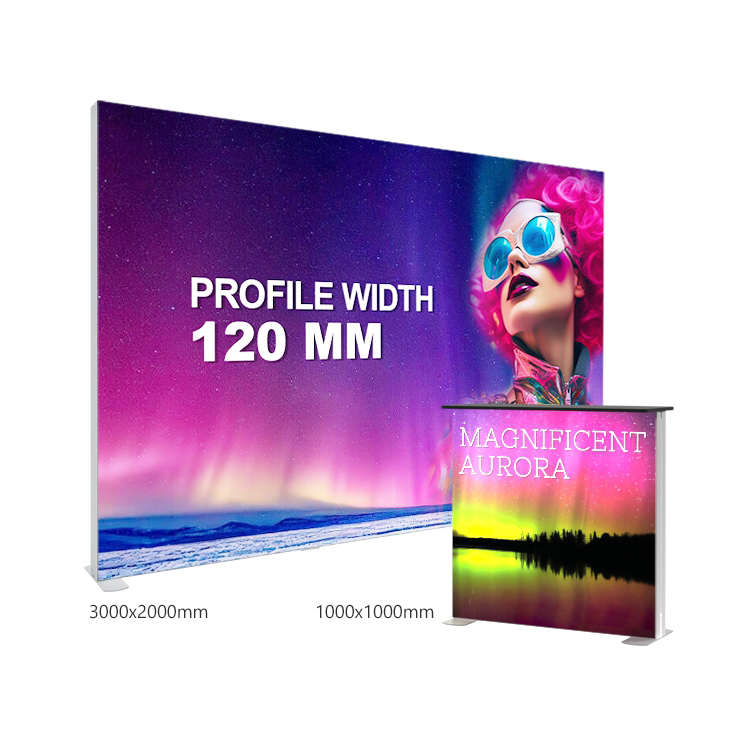
3. Check the SEG Graphic and Print Quality
The graphic is part of the lighting system, not just a printed surface.
A high-quality SEG graphic should provide:
Accurate fit
Smooth tension
Suitable light diffusion
Consistent print density
Easy replacement
Dye-Sublimation Printing
Dye-sublimation is widely used for polyester SEG graphics because it produces strong color reproduction while keeping the fabric flexible.
For backlit applications, graphics should be evaluated under actual illumination.
A print that looks sufficiently saturated when unlit may appear lighter after LED illumination.
The final appearance depends on:
Fabric + Print Density + Light Diffusion + LED Configuration
Graphic Fit Matters
The silicone strip sewn around the perimeter must fit the frame channel correctly.
Poor sizing or sewing accuracy can cause:
Wrinkles
Loose corners
Excessive tension
Difficult installation
This becomes particularly important when replacement graphics are produced separately from the original frame order.
Confirm Fire-Performance Documentation
Fire requirements vary by venue and destination market.
For some German exhibition applications, DIN 4102-B1 documentation may be requested. In the U.S., NFPA 701 is commonly referenced for textile applications.
These are different testing systems and should not be treated as equivalent.
Confirm the required documentation with the venue or organizer before graphic production.
4. Evaluate Setup, Packing and Reuse
For displays used repeatedly, installation and logistics can have as much impact on cost as the original frame price.
Evaluate the complete working cycle:
Transport → Setup → Display → Dismantle → Store → Reuse
Folding Structures for Faster Setup
Folding lightboxes reduce the number of loose frame sections and assembly steps.
In applicable Lintel folding configurations, internal testing has demonstrated frame deployment in approximately 10 seconds.
Specific basic configurations can be assembled in under one minute, compared with more than 10 minutes for selected conventional knock-down structures tested under the same internal conditions.
Actual setup time varies with frame size, graphics, electrical connection and accessories.
| Consideration | Folding Lightbox | Conventional Knock-Down Lightbox |
|---|---|---|
| Frame structure | Connected folding frame | Separate sections |
| Tools | Tool-free in applicable models | Depends on system |
| Loose parts | Fewer | More |
| Frame deployment | Approx. 10 sec in internal testing | Section-by-section assembly |
| Typical use | Frequent transport and setup | Less frequently moved installations |
Packing and Reuse
Before ordering, confirm:
Packing dimensions
Gross weight
Number of packages
Transport bag or case
LED component protection
Spare-part availability
Compact packing helps reduce storage requirements and simplifies movement between events.
Reusable frames also allow graphics to be replaced independently, which is valuable for:
Seasonal campaigns
Repeated exhibitions
Rental inventory
Product updates
For repeat-use projects, the better question is not simply:
What does the lightbox cost?
It is:
What will it cost to transport, install, update and reuse across multiple projects?
Fabric Lightbox Selection Checklist
Before confirming a specification, check:
Is the display freestanding, wall-mounted or suspended?
Is it viewed from one side or two?
Is edge lighting or direct backlighting more suitable?
Is the frame depth appropriate for the display size?
Is the SEG graphic designed for backlit use?
What fire-performance documentation is available?
Are tools required for setup?
What are the packed dimensions and weight?
Can graphics and LED components be replaced independently?
Is the frame intended for repeated use?
Frequently Asked Questions
Is edge lighting suitable for large fabric lightboxes?
It can be, but suitability depends on frame size, profile depth, LED optics and fabric diffusion. As display dimensions increase, maintaining uniform illumination becomes more demanding.
When should I choose a double-sided lightbox?
A double-sided lightbox is useful in open spaces where visitors approach from multiple directions, such as exhibition aisles, island booths and freestanding retail displays.
What should I check when ordering replacement SEG graphics?
Confirm the finished graphic dimensions, silicone strip specification, sewing tolerance, fabric type and print profile. Consistency is especially important when replacement graphics are produced separately from the original frame.
How quickly can a folding fabric lightbox be assembled?
In Lintel internal testing, applicable folding frames can be deployed in approximately 10 seconds, while specific basic configurations can be assembled in under one minute. Actual project setup time depends on frame size, graphics, electrical connection and accessories.
How long do LEDs last in a fabric lightbox?
Lintel uses applicable LED configurations rated for 50,000+ operating hours. Actual service life depends on operating conditions, power quality and maintenance.
Can the same fabric lightbox frame be reused with new graphics?
Yes. SEG graphics can normally be replaced independently while the aluminum frame is retained, making the system suitable for repeated exhibitions, seasonal campaigns and rental applications.
Choose the Lightbox Around the Project
The right fabric lightbox depends on how and where it will be used.
A slim retail installation may favor edge lighting. A large exhibition backwall may require direct backlighting. Open floor areas may benefit from a double-sided configuration, while frequently transported displays may place greater value on folding construction and compact packing.
The most useful comparison is therefore based on:
Space + Lighting + Graphics + Installation + Reuse
Lintel Display provides fabric lightbox and SEG display solutions for retail and exhibition applications, including freestanding, double-sided, modular and folding configurations.
Book a Design Consultation
Discuss your project dimensions, lighting configuration, SEG graphics, installation requirements and packing needs with the Lintel Display team.
marketing@lintel.com.cn
+86‑519‑68217886
www.linteldisplay.com


Recent News
1.How to Choose SEG Fabric Displays for Trade Shows and Backlit Signs
2026-08-132.How to Reduce Interstate Shipping Costs for Australian Trade Shows
2026-07-293.Why German Trade Shows Are Switching from Custom Builds to Modular Light Boxes
2026-07-244.Why B1 Fire Rating and CE/RoHS Certifications Matter for Your SEG Light Box Company
2026-07-02