



 Jul 24, 2026|
 View:322
Why German Trade Shows Are Switching from Custom Builds to Modular Light Boxes
German trade shows are among the most demanding in the world. With 350 to 380 international, national, and regional trade fairs held annually across 70 exhibition centres, Germany hosts around 16 million visitors each year. For exhibitors, the stakes are high: a poorly planned booth can mean missed connections, wasted budgets, and compliance penalties. Yet a fundamental shift is underway. Across Hannover Messe, IFA Berlin, Light+Building, and beyond, exhibitors are moving away from expensive, single-use custom builds toward reusable modular light box systems. The reasons are clear: modular light boxes offer dramatic cost savings, faster setup, compliance with Germany's strict safety regulations, and alignment with the country's aggressive sustainability agenda.

Key Takeaways
Modular light boxes cost 40–60% less over multiple shows – A 36 m² modular stand starts around €4,300–9,000, while a custom build of the same size typically runs €15,000–100,000+.
Setup time drops by up to 50% – Prefabricated aluminium frames and reusable components enable rapid on-site assembly, critical for German venues with strict build windows.
B1 fire-rated compliance is mandatory – German exhibition halls require B1-certified materials and CE/UL approved electronics. Modular light boxes with certified components eliminate last-minute venue rejections.
Sustainability is a regulatory requirement – Germany's trade fair industry has published national standards for calculating greenhouse gas emissions. Modular systems dramatically reduce waste and carbon footprints.
One investment, multiple configurations – A single modular light box kit adapts to different booth sizes—from 9 m² to 50 m² and beyond—without purchasing new hardware.
1. The Cost Reality: Why Custom Builds Are Becoming Unsustainable
The economics of exhibition stand construction in Germany have shifted decisively. A 24 m² custom-built stand with a meeting nook typically costs between €11,500 and €15,000. A modular stand of the same size? Between €5,500 and €8,500. That is a difference of roughly €4,500–€6,500 for a single show.
The divergence becomes more dramatic over multiple events. For a single show, a one-off custom and a one-off modular can land closer than most exhibitors expect. But on the second and third use, modular becomes mostly a graphics-and-logistics cost, while custom starts near zero again. The break-even point for choosing modular is roughly two shows per year.
Cost comparison: German trade show stands
| Stand Type | 18 m² | 24 m² with meeting area | 36 m² |
|---|---|---|---|
| Modular | €5,500–€8,500 | ~€7,500–€11,000 | €4,300–€9,000 |
| Custom | N/A | €11,500–€15,000 | €15,000–€100,000+ |
For exhibitors attending two or more German trade shows annually, the financial case for modular light boxes is compelling. A single 120mm modular light box system can support multiple booth configurations across different venues—from a compact 9 m² inline stand to a 50 m² island display—without requiring a new build for each show.
2. Speed and Efficiency: Meeting Germany's Strict Build Windows
German exhibition venues enforce rigorous timelines. Hannover Messe, for example, restricts assembly hours to 7 AM–10 PM. Frankfurt's Messe requires stand approval dossiers well in advance, with B1 certificates mandatory. Delays due to unfamiliarity with local norms—material certifications, structural safety checks, restricted hours—can lead to costly penalties.
Modular light boxes address this challenge directly. German-certified modular systems enable rapid on-site assembly. Prefabricated aluminium frames and reusable components reduce setup time by up to 50% while ensuring compliance. A case study showed a 500 m² booth built in just 7 days using pre-approved 3D designs and batch-shipped modules.
Setup time comparison (36 m² stand)
| Approach | Setup Time | Crew Required | Risk of Penalties |
|---|---|---|---|
| Custom build | 3–5 days | 5–8 professionals | High (venue rules, certification gaps) |
| Modular light box | 1–2 days | 2–3 people | Low (pre-approved components) |
The speed advantage is particularly valuable for international exhibitors. Traditional approaches relying on overseas teams often fail to navigate German complexities, resulting in missed deadlines and compromised brand visibility. Modular light boxes, with their standardised components and tool-free assembly, minimise these risks.
3. Compliance and Certification: Meeting German Safety Standards
German exhibition halls are among the most regulated in the world. B1 fire-resistant standards are mandatory for all materials. Structural safety checks (TV certification) are required. Electrical components must carry CE/UL marks.
A modular light box system that integrates these certifications eliminates last-minute venue rejections. One automotive client avoided €12,000 in fines by adhering to Stuttgart Exhibition Center's scheduling through proper local coordination. The lesson is clear: compliance failures are expensive.
Required certifications for German trade shows
| Certification | What It Covers | Why It's Mandatory |
|---|---|---|
| B1 fire rating (DIN 4102‑1) | Fabric and material flammability | Venue safety requirements |
| CE marking | Electrical safety of LED components | Legal requirement for EU markets |
| TV certification | Structural safety | Venue approval for stand construction |
Modular light boxes with pre-certified components simplify the approval process. Instead of submitting bespoke documentation for each custom build, exhibitors can reuse approved designs and certified components across multiple shows.
4. Sustainability: The Regulatory and Market Driver
Sustainability is no longer optional in the German trade fair industry. In March 2025, the Association of the German Trade Fair Industry (AUMA) published a national standard for calculating greenhouse gas emissions at trade fair events. As the AUMA stated: "Only what is measured can be reduced".
The German trade fair industry is actively working to keep materials in the loop, reduce waste, and develop practical solutions. According to UFI, a large international event can generate more than 500 tons of waste in a few days. This waste footprint is driving regulatory and market pressure for change.
Modular light boxes offer a solution. Aluminium frames are 100% recyclable. Fabric graphics are replaceable without discarding the entire structure. Some organisations have achieved more than 95% sustainability by reusing stand construction materials.
Sustainability comparison: modular vs custom
| Metric | Modular Light Box | Custom Build |
|---|---|---|
| Frame lifespan | 100+ shows | 1–2 shows |
| Material waste | Low (reusable) | High (single-use) |
| Carbon footprint | Lower per show | Higher per show |
| Alignment with German green standards | Yes | Partial |
5. Flexibility: One System, Multiple Venues
German trade shows take place across dozens of venues, from Messe Frankfurt to Messe München to Koelnmesse. Each has different hall heights, booth size limits, and build schedules. Custom builds are designed for one footprint—adjusting them for a different layout is expensive and often impossible.
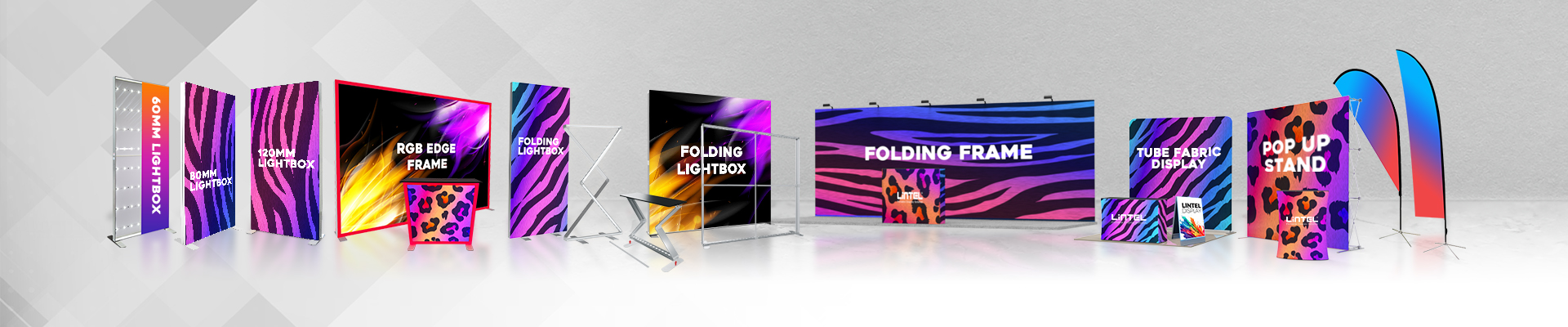
Modular light boxes, by contrast, are reconfigurable. The same 120mm aluminium profile system can scale from a compact 9 m² inline stand to a 36 m² island display to a 50 m² flagship booth. Angle connectors allow straight, L-shaped, and U-shaped configurations. Accessories—shelves, TV holders, brochure racks—attach without tools.
This flexibility is particularly valuable for exhibitors participating in multiple German shows across different cities. A single modular light box kit can serve Hannover Messe in April, IFA Berlin in September, and electronica Munich in November—with different configurations for each venue.
Frequently Asked Questions
What is a modular exhibition stand?
A modular exhibition stand is a reusable display structure made from standardized components that can be assembled into different configurations. It is designed to support multiple exhibitions rather than being built for a single event.
Is a modular light box booth suitable for German trade shows?
Yes. Modular light box booths can be used for German trade shows when the system, materials, electrical components, and installation comply with the requirements of the specific exhibition venue and event organizer.
Can a 10×10 ft light box booth be expanded into a 10×20 ft display?
Depending on the system architecture, modular light box systems can be configured for different booth footprints. Exhibitors should confirm the available frame sizes, connectors, and expansion options with the manufacturer before purchasing.
Is a reusable exhibition stand more cost-effective than a custom-built stand?
It can be, particularly for companies that participate in multiple exhibitions. The financial benefit depends on the number of events, booth size, logistics, labor, storage, and how many times the system can be reused.
What makes a sustainable exhibition stand?
A sustainable exhibition stand focuses on lifecycle efficiency. Reusable frames, replaceable graphics, repairable components, efficient transportation, and responsible end-of-life recycling can all contribute to a more sustainable exhibition solution.
What should international exhibitors consider when planning a trade show booth in Germany?
International exhibitors should consider venue regulations, fire performance requirements, electrical compliance, installation schedules, logistics, storage, and documentation requirements. The specific requirements should always be confirmed with the exhibition organizer or venue before production.
How can modular systems support exhibition contractors and rental companies?
A modular system can allow contractors and rental companies to reuse core structural components across multiple projects. This can simplify inventory management and create more flexible options for different booth sizes and client requirements.
Conclusion: The Shift Is Underway
German trade shows are switching from custom builds to modular light boxes because the economics, efficiency, and regulatory environment demand it. Modular systems cost 40–60% less over multiple shows, reduce setup time by up to 50%, meet Germany's strict B1 and CE/UL certification requirements, and align with the country's aggressive sustainability agenda.
Lintel Display has manufactured modular light box systems for over 30 years, serving customers in 138 countries. Our 120mm modular systems—with globally patented tool-free assembly, B1 fire-rated fabrics, and CE/UL certified electronics—are purpose-built for the German market. Whether you are exhibiting at Hannover Messe, IFA Berlin, or Light+Building, one modular light box system can support every booth size you need.
Ready to switch to a smarter exhibition solution?
marketing@lintel.com.cn
+86‑519‑68217886
www.linteldisplay.com
External Resources
AUMA – Association of the German Trade Fair Industry – German trade fair industry standards and sustainability guidelines
UFI – The Global Association of the Exhibition Industry – Global exhibition industry research and sustainability benchmarks
DIN 4102‑1 – B1 Fire Rating – European standard for fire safety of building materials
ISO 20121:2024 – Event Sustainability Management – International standard for sustainable event management
CEIR – Center for Exhibition Industry Research – Trade show performance and ROI research