


 Aug 13, 2026|
 View:93
How to Choose SEG Fabric Displays for Trade Shows and Backlit Signs
Choosing the right SEG fabric display involves more than selecting a frame size. Lighting method, frame depth, graphic fabric, installation environment, assembly method, and intended use all influence how the finished display will look and perform.
For exhibition companies, large-format printers, display distributors, and retail project teams, the right specification also affects transportation, installation labor, graphic replacement, and long-term reuse.
A compact retail light box, for example, has very different requirements from a large illuminated trade show backwall or a modular light box booth.
This guide explains the key factors professional buyers should evaluate when selecting a backlit SEG display.
Key Takeaways
When comparing SEG fabric displays, focus on five areas:
Lighting method: Direct backlighting and edge lighting suit different frame depths, sizes, and applications.
Frame depth: The correct profile should balance light diffusion, structural stability, and installation space.
SEG fabric: Diffusion, print quality, tension, and fire-performance documentation all matter.
Assembly and reusability: Tool-free and modular structures can simplify repeated installations.
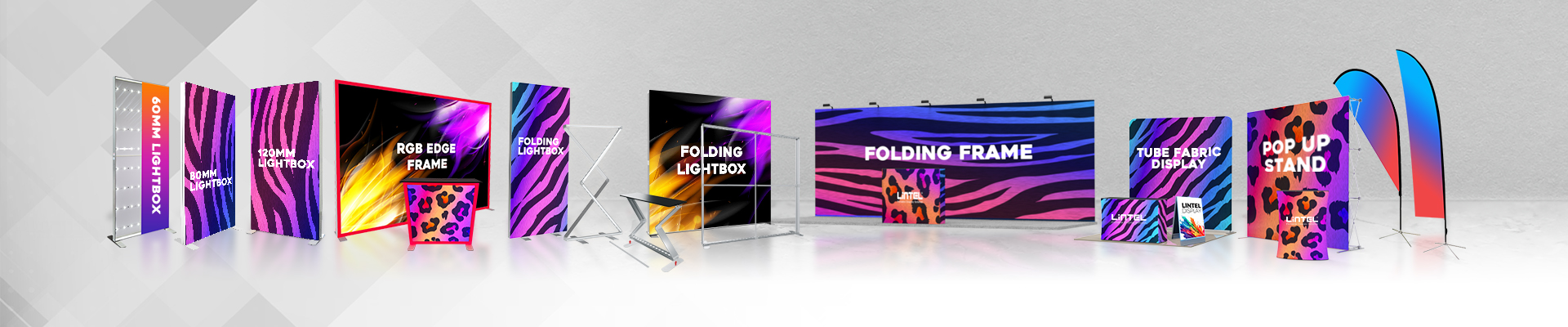
Application: Standard light boxes, RGB feature frames, modular booth systems, and folding displays solve different display requirements.
There is no single SEG light box specification that is best for every project. The right system starts with the environment in which it will be used.
1. Start with the Lighting Method: Direct Backlit vs. Edge-Lit
Illumination architecture has a major influence on brightness, frame depth, weight, and graphic appearance.
Most illuminated SEG displays use either direct backlighting or perimeter edge lighting.
Direct Backlit LED Systems
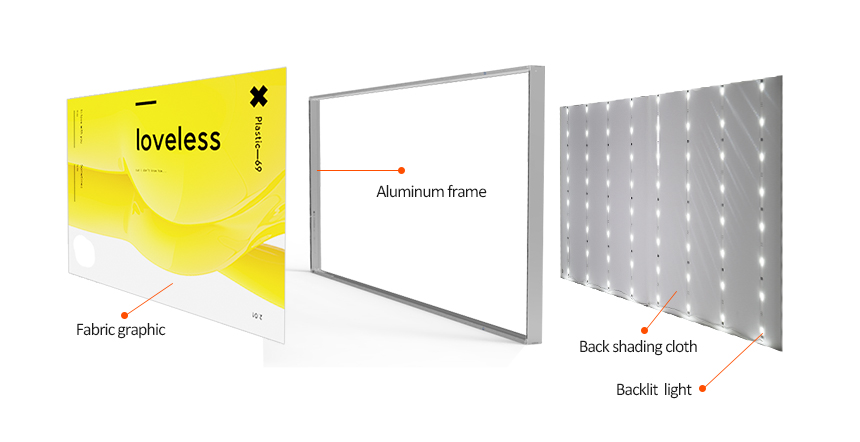
Direct backlit systems position LED modules behind the graphic, directing light forward through the printed textile.
When LED spacing, frame depth, and graphic diffusion are properly engineered, this configuration can provide highly uniform illumination across large graphic surfaces.
Direct backlighting is particularly suitable for:
Large trade show backwalls
Freestanding SEG light boxes
Large-format illuminated graphics
High-visibility retail environments
Displays where strong, even illumination is a priority
Because the LEDs sit behind the graphic, sufficient distance is required between the light source and fabric surface. For this reason, direct-backlit systems generally use deeper profiles than slim edge-lit light boxes.
Perimeter Edge-Lit Systems
Edge-lit systems position LED strips around the inside perimeter of the frame and direct light toward the center.
This architecture can support slimmer frame designs and is often useful where installation depth is limited.
Typical applications include:
Wall-mounted retail light boxes
Interior signage
Compact promotional displays
Shallow architectural installations
Light uniformity in larger edge-lit displays depends heavily on frame dimensions, optical design, LED output, and internal light distribution.
| Consideration | Direct Backlit | Edge-Lit |
|---|---|---|
| LED position | Behind the graphic | Around the frame perimeter |
| Typical profile | Deeper | Shallower |
| Large-format suitability | Very good | Depends on size and optical design |
| Light distribution | Strong, uniform when properly engineered | Requires careful perimeter diffusion |
| Typical applications | Trade show backwalls, freestanding displays | Retail signage, wall-mounted displays |
| Installation depth | Requires more space | Useful where depth is limited |
The decision should therefore be based on display size, available installation depth, required brightness, ambient lighting, and portability, rather than lighting technology alone.
2. Choose the Right Frame Depth
Profile depth is not simply a cosmetic specification. It influences internal light distribution, structural rigidity, overall weight, and how the display can be installed.
Shallower profiles can be useful for wall-mounted and space-sensitive applications, while deeper profiles provide more internal space for direct LED backlighting and can offer greater rigidity for larger freestanding structures.
Common SEG frame depths may include options around:
30 mm
60 mm
80–85 mm
120 mm
However, buyers should not choose a profile based on depth alone.
Instead, ask:
| Frame Consideration | What Buyers Should Check |
|---|---|
| Lighting method | Is the profile engineered for direct backlighting or edge lighting? |
| Maximum frame size | What dimensions can the system support reliably? |
| Structural rigidity | Is additional support required for large freestanding walls? |
| Joint quality | Are seams and corners accurately aligned after repeated assembly? |
| Connector design | Does assembly require tools or specialist labor? |
| Installation type | Is the frame wall-mounted, freestanding, suspended, or part of a booth system? |
| Reusability | Are connectors and frame components designed for repeated assembly? |
For large exhibition projects, structural performance becomes increasingly important as frame width and height increase.
A well-engineered profile should maintain graphic tension and frame alignment throughout the event without introducing unnecessary installation complexity.
3. Evaluate the SEG Fabric, Not Just the Frame
The graphic is an integral part of an illuminated SEG system.
A high-quality frame cannot compensate for fabric that has poor light diffusion, inadequate print density, incorrect sizing, or inconsistent silicone edge finishing.
For a backlit SEG display, professional buyers should evaluate four characteristics.
Light Diffusion
Backlit textile should distribute LED light evenly across the visible graphic surface.
Poor diffusion can make individual LED positions more noticeable, particularly when the frame is shallow or LED spacing is too wide.
Hot spotting is therefore influenced by the complete lighting system: LED spacing + LED-to-fabric distance + optical design + fabric diffusion — not by printing technology alone.
Print Quality
Dye-sublimation printing is widely used for polyester SEG graphics because the process can produce strong color reproduction while retaining the flexibility of the textile.
For illuminated graphics, print density is particularly important. A graphic that looks acceptable without lighting may appear washed out once illuminated from behind.
Buyers should therefore evaluate backlit graphics under actual illumination rather than judging an unlit print alone.
Graphic Tension and Fit
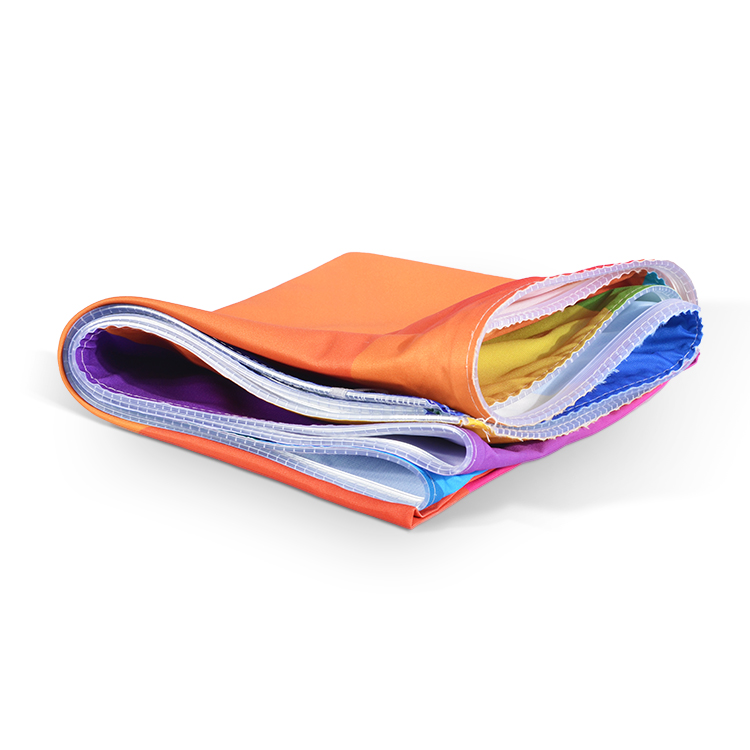
The silicone edge sewn around the fabric must match the frame channel correctly.
When the graphic dimensions and silicone finishing are properly controlled, the fabric sits taut across the frame with minimal wrinkling.
Poor sizing can result in:
Loose graphic surfaces
Distorted corners
Excessive tension
Difficult graphic installation
This becomes particularly important for companies ordering replacement graphics from different printing locations.
Fire Performance
Exhibition venues may require documentation relating to the fire performance of display textiles.
Requirements vary by country, venue, organizer, and application.
For example, DIN 4102-B1 may be requested for certain German exhibition applications, while NFPA 701 is commonly referenced for textile flame-propagation testing in U.S. projects.
These standards use different test methods and should not be treated as interchangeable certifications.
Before production, buyers should confirm the documentation required by the specific exhibition venue or project.
4. Match the SEG Display System to the Application
Not every illuminated SEG project needs the same type of frame.
A useful way to choose is to start with how the display will actually be used.
Standard Backlit SEG Light Box
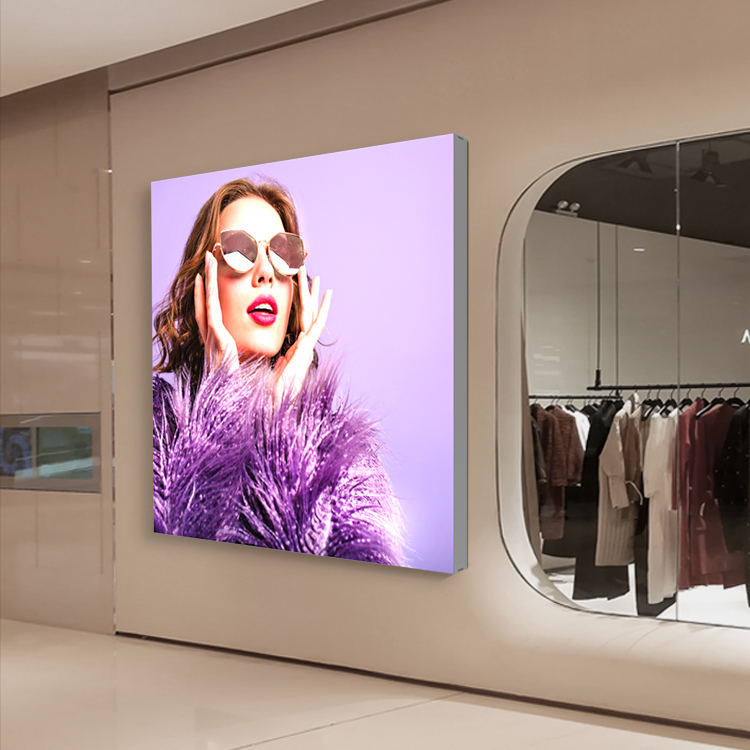
Choose a conventional backlit SEG light box when the main requirement is a clean, evenly illuminated graphic.
Typical applications include:
Retail branding
Shopping malls
Showrooms
Exhibition backwalls
Corporate interiors
Promotional displays
The priority should be lighting uniformity, graphic quality, appropriate frame depth, and reliable construction.
5. When Does an RGB SEG Frame Make Sense?
Standard white LED illumination is usually the right choice when the graphic itself is the primary visual focus.
RGB illumination serves a different purpose. It can add dynamic color to the frame or surrounding visual environment, helping a display become a stronger architectural or promotional feature.
RGB SEG frames are particularly useful for:
Retail entrances and windows
Product launch areas
Promotional zones
Exhibition feature walls
Brand activations
High-visibility event environments
For these applications, buyers should evaluate more than the number of available colors.
Important considerations include:
Control simplicity
Lighting consistency
Preset and dynamic lighting modes
Maintenance access
Graphic compatibility
Electrical reliability
Assembly method
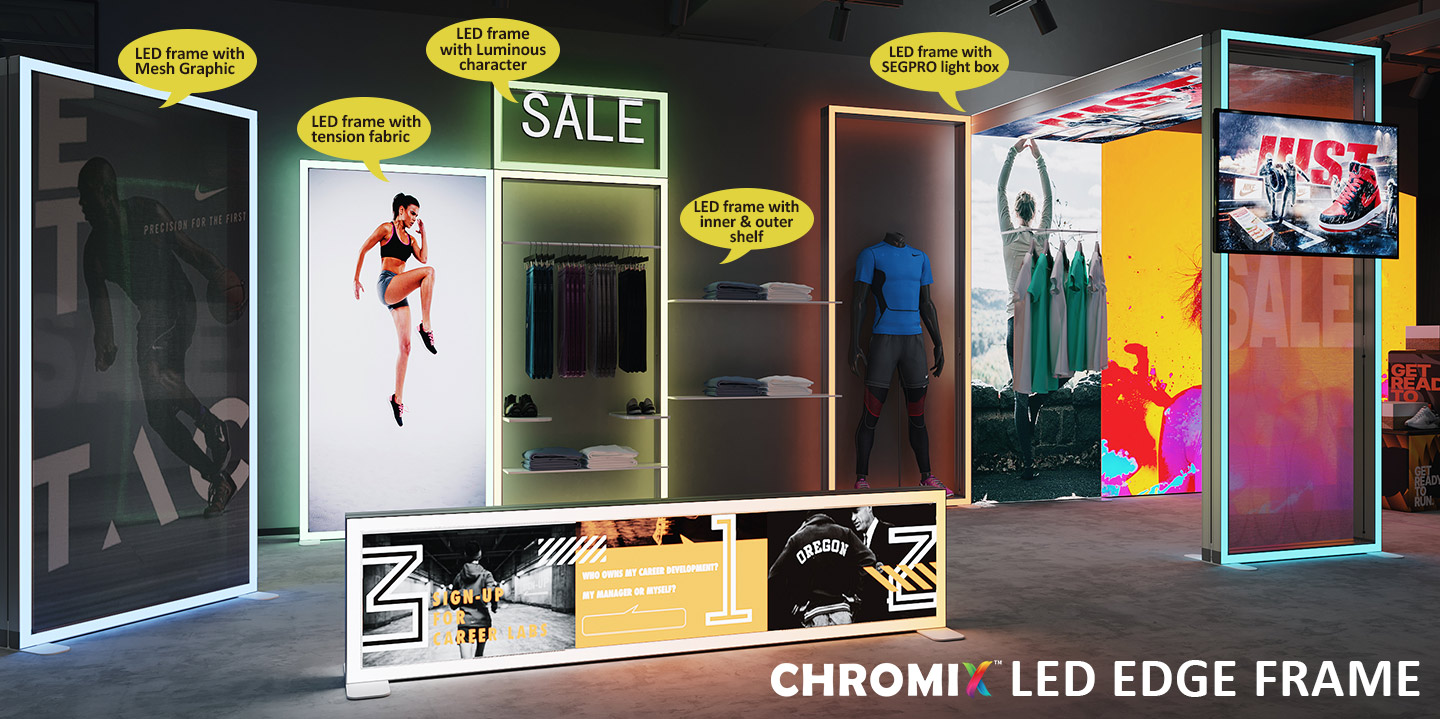
Example: CHROMIX™ RGB Frame System
Lintel Display's CHROMIX™ RGB Frame System is designed for projects where the illuminated frame itself becomes part of the visual experience.
Depending on the selected CHROMIX™ configuration, the system can be used to create distinctive illuminated structures for retail, exhibition, and branded environments.
Rather than replacing conventional SEG light boxes in every application, RGB frames are best specified where dynamic illumination contributes directly to the design concept and audience experience.
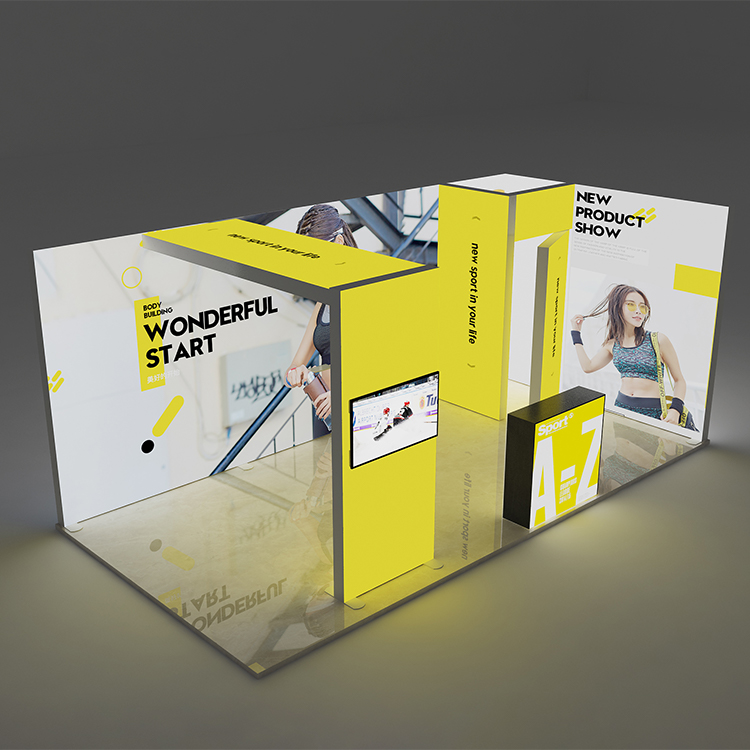
6. Choose a Modular SEG System for Exhibition Booths
A single SEG light box and a complete exhibition booth are not the same engineering requirement.
Exhibition companies, rental businesses, and frequent exhibitors often need multiple illuminated frames to work together as one reusable display environment.
In this case, buyers should consider a modular SEG display system rather than purchasing independent light boxes.
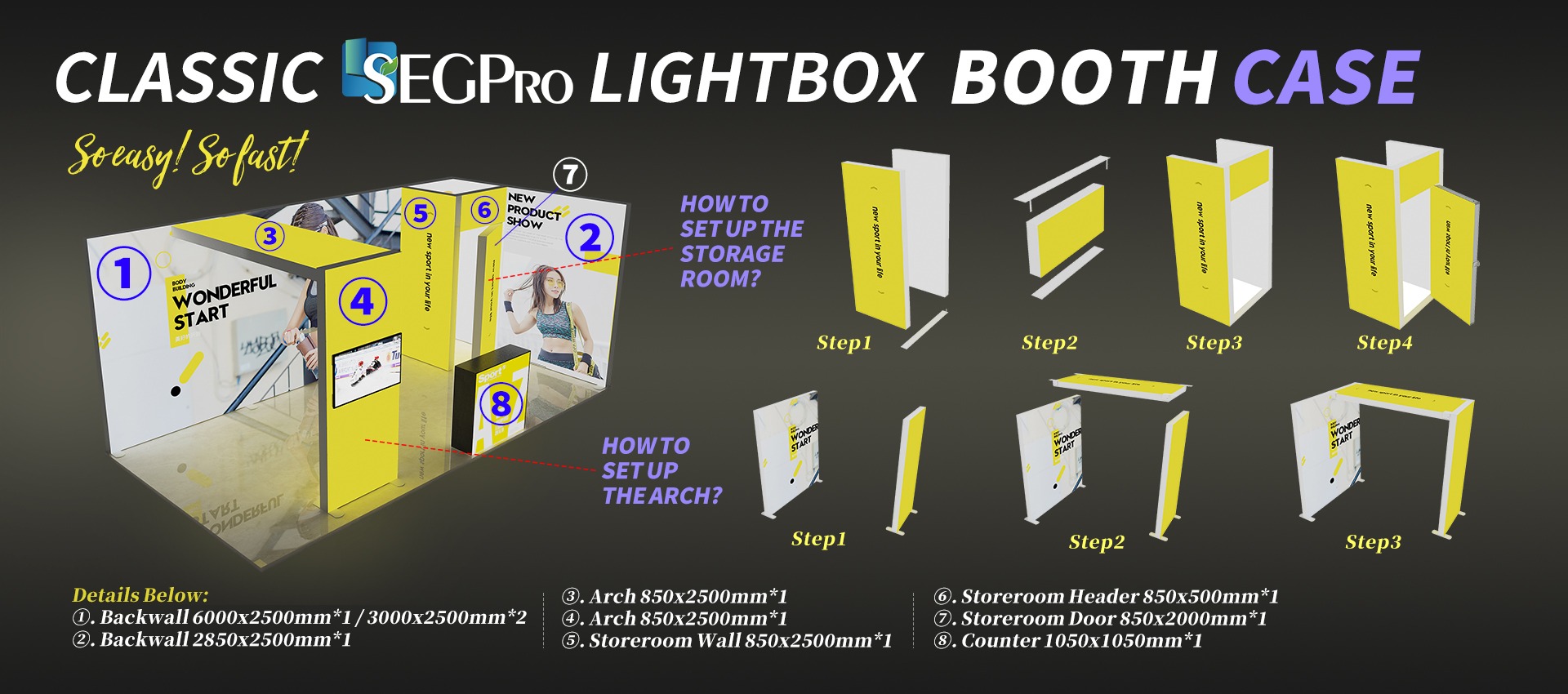
A modular system can support configurations such as:
Straight illuminated backwalls
L-shaped booth layouts
Multi-wall exhibition spaces
Meeting areas
Product presentation zones
Larger modular light box booths
The main advantage is reconfiguration. Instead of building a completely new display for each event, selected structural components can be reused while the booth layout and SEG graphics change.
Example: SEGPRO® Light Box System
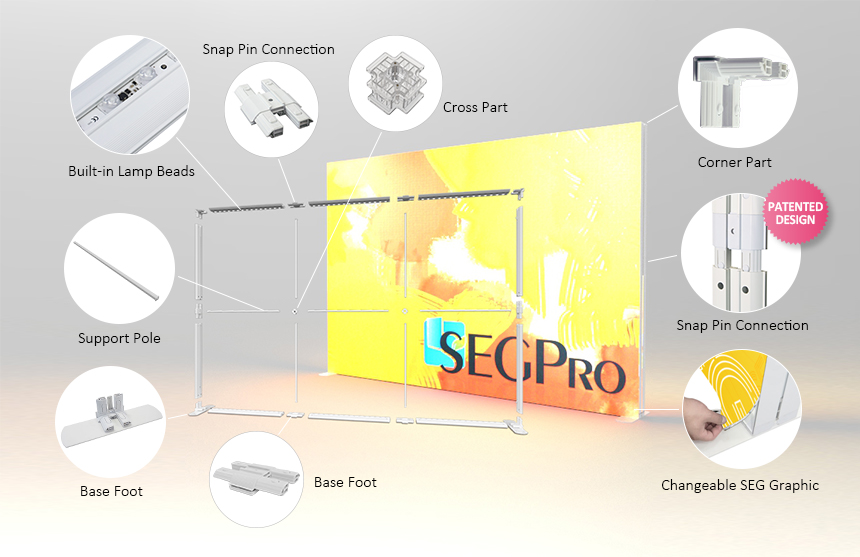
The SEGPRO® Light Box System is Lintel Display's modular solution for professional exhibition environments.
Its modular frame architecture and connection system allow compatible light box components to be configured into different booth layouts.
For professional buyers, the important questions are not simply how quickly one frame can be assembled, but:
How do multiple frames connect?
What booth configurations are supported?
Can components be reused in future layouts?
How easily can graphics be replaced?
How are electrical components managed?
What accessories can be integrated?
How is the system packed and transported?
These factors determine whether a light box is simply a display product or part of a practical long-term exhibition system.
7. Choose a Folding SEG Display for Frequent Transport
Not every exhibitor needs a multi-frame modular booth.
For roadshows, short-term promotions, regional exhibitions, and projects where displays move frequently between locations, portability may be more important than extensive booth configuration.
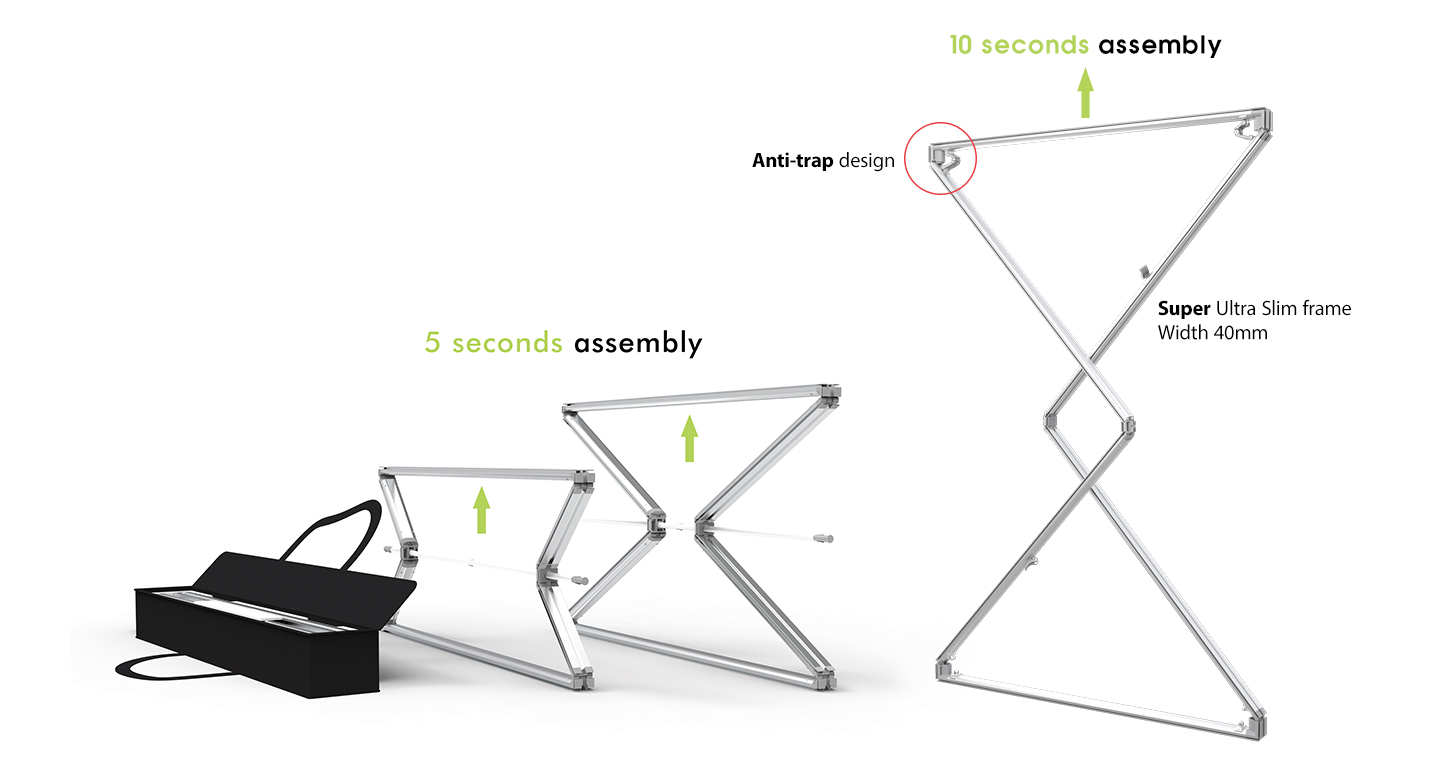
In these situations, a folding SEG frame can reduce the number of loose components and simplify deployment.
Buyers should evaluate:
Folded packing dimensions
Total packed weight
Setup procedure
Frame stability after unfolding
Graphic installation
LED integration
Transport protection
Durability of hinges and locking components
Example: XQUIC™ Folding SEG Frame System
Lintel Display's XQUIC™ Folding SEG Frame System uses a collapsible frame architecture designed for rapid deployment and compact transportation.
The folding structure reduces the amount of frame assembly required on site, making it particularly suitable for display businesses that prioritize portability and repeated setup.
For frequent-use applications, buyers should consider not only setup speed but also the long-term durability of the folding mechanism, replaceability of components, and quality of the transport packaging.
8. Standard, RGB, Modular or Folding: Which SEG Display Should You Choose?
The right SEG system depends on the job it needs to perform.
| Project Requirement | Recommended Display Type | Main Selection Priority |
|---|---|---|
| Retail wall graphic | Standard SEG light box | Slim profile and graphic quality |
| Large illuminated exhibition backwall | Direct-backlit SEG display | Uniform lighting and frame stability |
| Dynamic promotional environment | RGB SEG frame | Lighting control and visual effect |
| Multi-frame trade show booth | Modular SEG display system | Connectivity and reconfiguration |
| Frequent roadshows or events | Folding SEG display | Fast deployment and transport efficiency |
| Repeated exhibition program | Reusable modular light box booth | System compatibility and long-term reuse |
This application-first approach prevents buyers from over-specifying simple projects or choosing a frame that cannot support future requirements.
9. SEG Display Buyer Checklist
Before placing a bulk or project order, confirm the following with your manufacturer.
Lighting
Is the system direct backlit or edge-lit?
What LED configuration is used?
How is illumination uniformity managed?
Can LED components be replaced?
Frame
What profile depth is recommended for the application?
What are the recommended maximum frame dimensions?
Is the display wall-mounted, freestanding, or modular?
How are corners and multiple frames connected?
Graphics
What backlit fabric is recommended?
What printing method is used?
How is the silicone edge finished?
What fire-performance documentation is available?
Installation
Are tools required?
How many frame components must be assembled?
Are LEDs pre-installed?
Are installation instructions or videos available?
Reuse and Logistics
Can graphics be replaced independently?
Can the frame be reconfigured for another application?
What are the packing dimensions and weight?
Are transport cases available?
Can replacement components be ordered separately?
Compliance
Which electrical certifications are available?
Which textile fire-performance reports are available?
Are documents suitable for the destination market?
Does the project require additional venue-specific approval?
For B2B buyers, these questions often reveal more about the long-term value of a SEG system than the initial unit price alone.
10. Think Beyond the Initial Purchase Price
A backlit display should not be evaluated only by frame cost.
For exhibition contractors, rental companies, printers, and distributors, the total operating cost can also include:
Graphic replacement
Installation labor
Transportation
Storage
Replacement parts
Electrical maintenance
Reconfiguration for future projects
A lower-priced frame may not represent the lower-cost solution if it requires more labor, occupies more shipping volume, or cannot be reused for future configurations.
Conversely, not every project requires an advanced modular system. A permanent retail wall installation may benefit more from a simple, well-engineered light box than from additional modular functionality that will never be used.
The most effective purchasing decision is therefore based on application, expected reuse, logistics, and total cost of ownership.
Frequently Asked Questions
What is a SEG fabric display?
A SEG fabric display uses a printed textile graphic with a silicone strip sewn around its perimeter. The silicone edge is inserted into a channel in the frame, creating a smooth, tensioned graphic surface. SEG graphics can be used with non-illuminated frames or LED-backlit light boxes.
What is the difference between a SEG display and a SEG light box?
A SEG display refers broadly to a frame using silicone edge graphics. A SEG light box adds an internal LED lighting system that illuminates the graphic. Not every SEG display is illuminated.
What profile depth is best for a direct-backlit SEG light box?
There is no universal profile depth for every direct-backlit display. The correct depth depends on LED spacing, light output, frame dimensions, fabric diffusion, and required brightness. Deeper profiles generally provide more distance for light diffusion and are commonly used for larger direct-backlit applications.
Is direct backlighting better than edge lighting?
Neither method is universally better. Direct backlighting is often preferred for larger displays requiring strong, uniform illumination, while edge lighting can be useful for slimmer installations where frame depth is limited.
What causes hot spots in a backlit SEG display?
Visible hot spots can result from insufficient distance between the LEDs and graphic, inappropriate LED spacing, uneven light output, poor optical design, or inadequate fabric diffusion. Lighting and graphic materials should therefore be engineered as one system.
What fabric should be used for backlit SEG displays?
Backlit SEG displays generally require polyester textile engineered for light diffusion and illuminated printing. Buyers should evaluate diffusion, print density, stretch characteristics, silicone edge quality, and any required fire-performance documentation.
Do exhibition SEG fabrics need to be fire retardant?
Requirements vary by venue, country, and event organizer. Buyers should confirm the required fire-performance documentation before production rather than assuming that one certification applies to every exhibition market.
Are modular SEG light boxes suitable for trade show booths?
Yes. A modular SEG light box system can be suitable for reusable exhibition booths when compatible frames, connectors, lighting, graphics, and accessories are engineered to work together. This is particularly useful for exhibition companies and rental businesses that need to reconfigure inventory across multiple projects.
When should I choose a folding SEG display?
Folding SEG displays are particularly useful when portability, compact packing, and rapid repeated deployment are priorities, such as roadshows, regional exhibitions, short-term promotions, and frequently transported display inventory.
Choosing the Right SEG Display Starts with the Application
The best SEG fabric display is not necessarily the deepest frame, the brightest LED system, or the most complex modular structure. It is the system that matches the application.
For a retail wall installation, that may mean a slim and clean backlit light box. For a large exhibition backwall, lighting uniformity and structural stability may take priority. For a reusable trade show booth, modular connectivity becomes more important. For frequent transport, a folding system may provide greater operational efficiency. And when dynamic illumination is part of the creative concept, an RGB frame can provide an additional visual dimension.
With decades of experience in display manufacturing, Lintel Display develops multiple SEG display platforms for different professional applications, including CHROMIX™ RGB Frame System, SEGPRO® Light Box System, and XQUIC™ Folding SEG Frame System.
Rather than starting with a specific product, our team can help evaluate the display environment, frame configuration, lighting method, graphics, logistics, and reuse requirements before recommending a system.
Planning a backlit retail display, trade show light box, or modular SEG booth?
marketing@lintel.com.cn
+86‑519‑68217886
www.linteldisplay.com
Book a design consultation with Lintel Display to discuss your dimensions, application, lighting requirements, graphics, installation method, and project specifications.