


 Jul 15, 2026|
 View:387
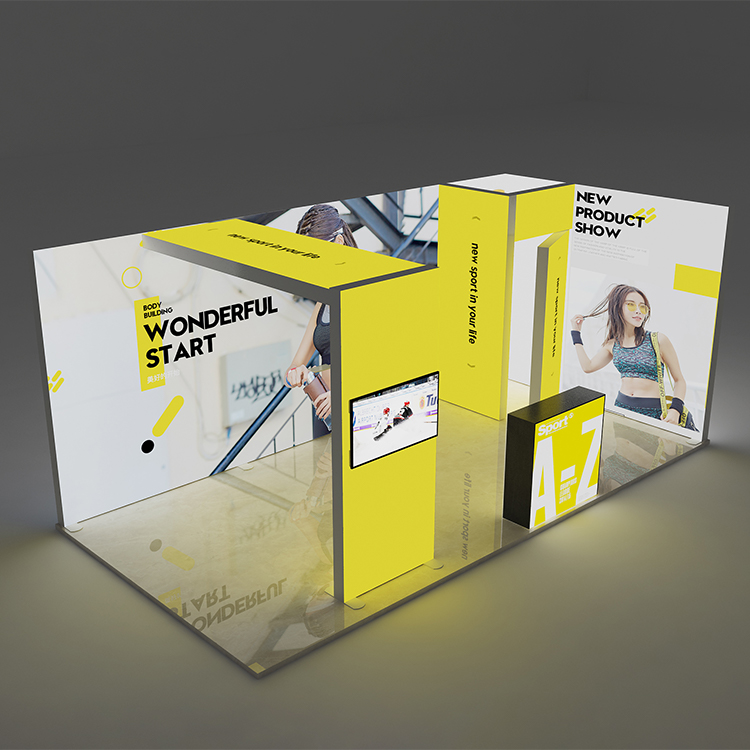
Exhibiting at multiple trade shows each year is expensive—not just because of booth space rental, but because of the hidden costs that accumulate with every event: freight, drayage, installation labour, storage, and the cycle of rebuilding from scratch. A modular exhibition display system changes that equation entirely. One aluminium frame kit can be reconfigured into a 10×10 inline booth, a 10×20 backwall, a 20×20 island, or any size in between—using the same components, the same investment, and the same brand graphics, refreshed with new fabric panels. For exhibition companies, advertising agencies, printers, and rental operators serving the European and American markets, the ROI of modular exhibition displays is not theoretical—it is measurable, predictable, and increasingly the industry standard.
Key Takeaways
One investment, unlimited configurations – A modular exhibition display system uses standardised aluminium frames and connectors that reconfigure into multiple booth sizes—from 10×10 to 10×20 to island layouts—without purchasing new hardware for each show.
Total cost of ownership drops by 40–60% over three shows – Independent comparisons show modular exhibition stands cost €7,000–€15,000 across three shows, while custom builds run €18,000–€30,000 for the same period.
Setup time shrinks from days to hours – Traditional timber custom booths require 12–24 hours of on-site labour. Modular aluminium systems assemble in 4–8 hours, saving €800–€2,400 per show in European labour costs.
Shipping weight drops by 35–55% – Aluminium frame systems weigh significantly less than timber custom builds, reducing freight, drayage, and storage costs across every event.
Sustainability is no longer optional – Nearly half (46%) of expo booth materials end up in landfill after just four shows. Modular systems are built from 100% recyclable aluminium and can be reused indefinitely.
1. What Makes a Modular Exhibition Display System Different?
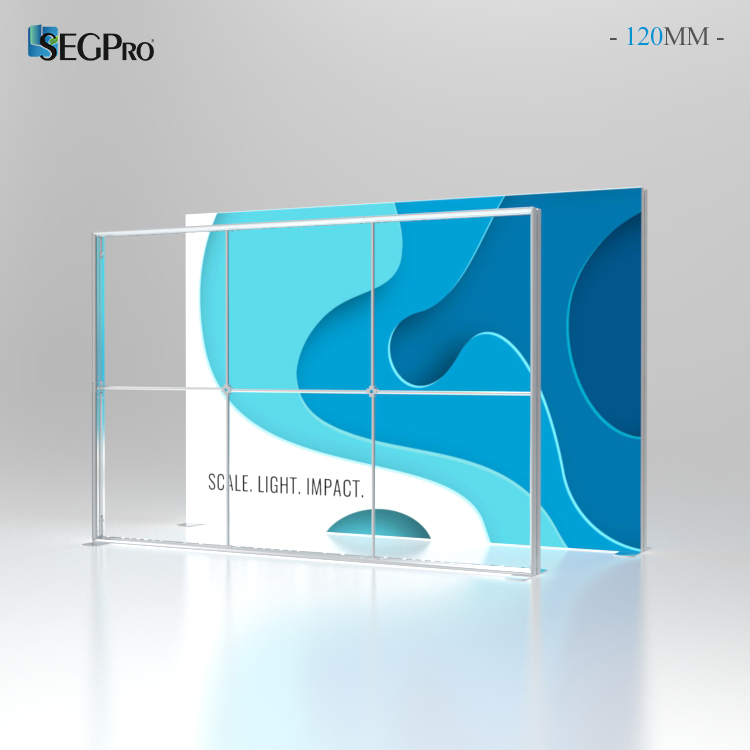
A modular exhibition display system is built from repeatable, standardised components—most commonly aluminium extrusion profiles, SEG (silicone-edge graphic) fabric panels, light box modules, and click-fit connectors. These components assemble without tools or with simple hand-tightened connections.
The core difference from custom builds:
| Attribute | Modular Exhibition Display | Custom-Built Stand |
|---|---|---|
| Structure | Standardised aluminium frames, reusable | Bespoke timber/MDF, typically single-use |
| Assembly | Tool-free or simple hand-tightening | Power tools, professional crew required |
| Reusability | Reconfigured across multiple shows | Designed for one footprint |
| Graphic updates | Replace fabric panels only | Full rebuild required |
| Material lifecycle | 100% recyclable aluminium | Often ends in landfill |
The global modular booth market was valued at US$2.419 billion in 2025 and is projected to reach US$3.762 billion by 2032, growing at a CAGR of 6.3%. This growth reflects a fundamental shift: exhibition professionals are moving away from disposable custom builds toward reusable, reconfigurable systems that deliver better long-term value.
2. The Cost Comparison: Modular vs Custom Over Three Shows
The most compelling evidence for modular exhibition displays comes from the numbers. A 20m² stand at a major European exhibition centre tells the story clearly:
| Cost Component | Modular Stand | Custom Stand |
|---|---|---|
| First-show construction | €4,000–€9,000 | €8,000–€18,000 |
| Second show | €1,500–€3,000 | €3,200–€10,800 |
| Third show | €1,500–€3,000 | €3,200–€10,800 |
| Total over 3 shows | €7,000–€15,000 | €18,000–€30,000 |
The modular exhibition display option is 40–60% cheaper across a multi-show programme.
The savings come from multiple sources. Custom stands are typically rebuilt at 40–60% of the original cost for each subsequent show because timber and MDF structures do not survive disassembly intact. Modular systems, by contrast, amortise the frame cost across dozens of events; each subsequent show costs only reprinted graphics and, if needed, a few extra components.
For exhibitors attending three or more shows per year, modular systems can pay for themselves in just 12 to 18 months.
3. Setup Time and Labour Savings
Time on the show floor is expensive. Union labour rates at major European and American convention centres add hundreds of dollars per hour to installation costs.
Setup time comparison:
| Display Type | Setup Time | Crew Required | Estimated Labour Cost (per show) |
|---|---|---|---|
| Custom timber booth | 12–24 hours | 3–5 professionals | €1,800–€4,800+ |
| Modular aluminium system | 4–8 hours | 1–2 people | €800–€2,400 |
Modular exhibition display systems cut on-site labour time by 50–70%. The tool-free assembly means one or two people can handle the entire installation without specialised contractors. This not only reduces direct labour costs but also eliminates the logistical headache of coordinating external crews across multiple shows.
4. Shipping, Freight, and Logistics Savings
Transportation costs have become a persistent challenge for the trade show industry. Shipping a heavy, traditional exhibit to five, ten, or fifteen shows can quickly drain budgets.
How modular systems reduce logistics costs:
| Cost Factor | Modular System | Custom Build | Savings |
|---|---|---|---|
| Shipping weight | 35–55% lighter | Heavy timber/MDF | Lower freight costs per trip |
| Packing volume | Compact, stackable | Bulky, irregular | Fewer pallets, lower drayage |
| Storage | Small footprint | Large warehouse space | Lower long-term storage fees |
Aluminium frames pack compactly and nest together during transport, reducing the number of pallets required. Fewer pallets mean quicker drayage handling and more time for installation once materials arrive on the show floor. Domestic shipping for modular systems often runs $300–$600, compared to $1,200+ for oversized custom freight.
5. Sustainability: The Environmental Case for Modular
The exhibition industry generates enormous waste. Nearly half (46%) of expo booth materials end up in landfill after just four shows. A custom stand built from MDF, chipboard, and single-use timber typically generates 0.8–1.5 tonnes of waste after a single event. Industry estimates suggest the trade show industry sends as much as 600,000 tons of waste to landfill every year.
Modular systems offer a radically different model:
Aluminium frames are 100% recyclable and can be reused indefinitely
A modular system can reduce waste by up to 70% compared to timber custom builds
Modular exhibition systems produce 70% less material waste per event than single-use alternatives
Some organisations have achieved 95%+ sustainability by reusing stand construction materials
Sustainability now ranks among the top strategic priorities for event organisers worldwide, according to UFI, the global association of the exhibition industry. Choosing a reusable modular exhibition display system is one of the most effective ways exhibitors can reduce their environmental footprint while simultaneously cutting costs.
6. Who Benefits Most from Modular Exhibition Displays?
Exhibition Companies
For firms that design, build, and manage booths for multiple clients, modular systems offer consistent branding, predictable costs, and faster turnaround times. One system can serve clients ranging from 10×10 inline booths to 20×20 island exhibits—without maintaining separate inventory for each size.
Advertising Agencies
Agencies need to deliver fresh creative concepts for each campaign. Modular systems allow graphic updates in minutes by replacing fabric panels, not rebuilding the entire structure. This speed-to-market advantage is critical when client deadlines are tight.
Printers
Printers who supply fabric graphics for SEG light boxes benefit from the modular system's standardised sizing. Once the frame dimensions are known, graphics can be printed and installed with precision, eliminating the waste and rework common with custom-shaped builds.
Rental Operators
For rental companies, modular systems are a fleet asset. The same inventory serves multiple clients across different show sizes and locations. Durability is proven: aluminium frames withstand 100+ assembly cycles, and modular systems can be reused for 5–8 years with annual component replacement rates below 15% by weight.
7. Frequently Asked Questions
How many different booth sizes can one modular system support?
One aluminium frame kit can reconfigure from 10×10 inline to 10×20 backwall to 20×20 island configurations—and everything in between—using the same components and standardised connectors.
What is the payback period for a modular exhibition display?
For exhibitors attending three or more shows per year, modular systems typically pay for themselves in 12 to 18 months.
How durable are aluminium modular frames?
High-grade aluminium frames withstand 100+ assembly cycles. Many exhibitors use the same frame for 5+ years, updating only the fabric graphics when brand messaging changes.
What certifications should a modular display system have?
Look for systems with CE/UL certified electronics, B1 fire-rated fabrics (DIN 4102‑1), and RoHS compliance for hazardous substances.
Can I change graphics between shows without replacing the frame?
Yes. SEG fabric graphics are replaced in minutes without tools. The frame is reusable; only the printed fabric needs updating for each campaign.
Is a modular display as visually professional as a custom build?
Modern modular systems achieve 85–92% of the visitor stop rate of equivalent custom builds when designed with open layouts and integrated LED lighting. Fabric tension systems and high-resolution digital printing have narrowed the quality gap significantly.
Conclusion: The ROI Is Clear
One system, ten booth sizes—the ROI of modular exhibition displays is not speculation. It is documented in cost comparisons, labour savings, freight reductions, and sustainability metrics that benefit exhibition companies, advertising agencies, printers, and rental operators across Europe and America.
Lintel Display has manufactured modular exhibition systems for over 30 years, serving customers in 138 countries. Our modular light box systems—built from 120mm aluminium profiles with globally patented tool-free assembly—reconfigure from 3×3 to 6×3 to 10×10 and beyond, using the same frames, the same investment, and the same reusable components. SEG fabric graphics are replaced in minutes, not days. B1 fire-rated fabrics and CE/UL certified electronics meet international exhibition hall safety standards.
Whether you manage a rental fleet, design booths for global brands, or print graphics for trade show campaigns, modular exhibition displays deliver the ROI that traditional custom builds cannot match.
Ready to calculate your modular exhibition display ROI?
marketing@lintel.com.cn
+86‑519‑68217886
www.linteldisplay.com
External Resources
CEIR – Center for Exhibition Industry Research – Industry research on trade show performance and ROI
UFI – The Global Association of the Exhibition Industry – Global standards and sustainability benchmarks for exhibitions
ISO 20121:2024 – Event Sustainability Management Systems – International standard for sustainable event management
DIN 4102‑1 – B1 Fire Rating – European standard for fire safety of building materials
The Aluminum Association – 6063 Alloy Properties – Material specifications for aluminium exhibition frames