



How to Choose an Aluminum SEG Frame Manufacturer: Quality, Compliance & Supplier Checklist
 Sep 01, 2026|
 View:183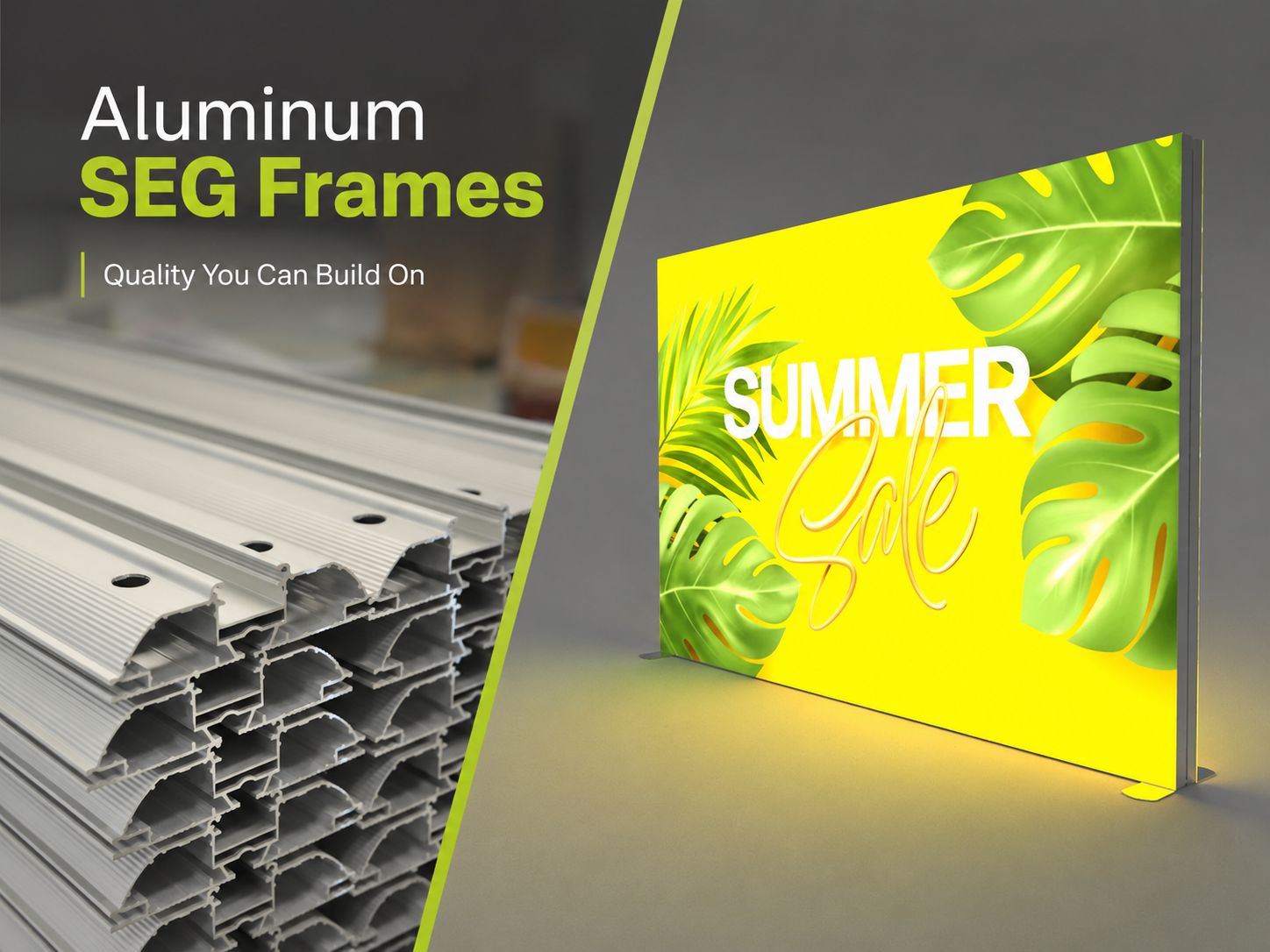
If you source display hardware for a living, sizing up an aluminum SEG frame manufacturer is rarely as simple as comparing prices. The frame is the invisible backbone of every SEG lightbox you resell: it holds the fabric taut, keeps backlight even, and either survives dozens of trade shows or lets you down on the first one. Get the supplier wrong, and the problems show up later as sagging fabric, color drift across reorders, or a venue that rejects your display for missing fire documentation.
This guide is written for procurement managers and category buyers at display distributors. Instead of just naming suppliers, it builds the evaluation framework you can use to vet any aluminum SEG frame manufacturer — the build-quality criteria, the compliance documents to demand, and the red flags that should end the conversation early. At the end, you will have a repeatable scorecard for comparing candidates on evidence rather than on marketing copy.
Key Takeaway: The best aluminum SEG frame manufacturer is the one that can prove quality with documentation — alloy and tolerances, finish test results, and certifications — not just the one with the lowest unit price.
Start With Your Requirements, Not a Vendor List
Before you look at any supplier, define what your product line actually needs. Frame depth, mounting style, customization, lighting, and order volume all change who the right aluminum SEG frame manufacturer is for your business.
Work through a short needs assessment:
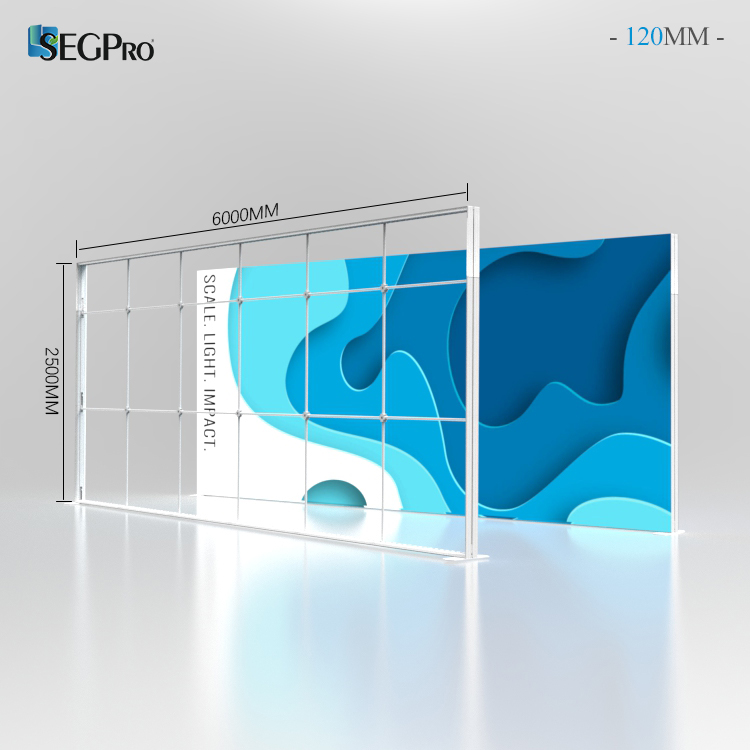
Frame type: Are you sourcing slim wall-mounted frames, freestanding designs, or deep backlit lightboxes? Depth requirements differ sharply — wall frames can run about 20 mm, while backlit units often need 100 mm or more of structure.
Lighting: Do your frames ship with integrated LEDs, or are they unlit graphics frames? If lit, who supplies the LED driver and how is its lifespan documented?
Customization: Do you need custom sizes, shapes, or brand-matched finishes like powder coating? This narrows the field to manufacturers with real extrusion and finishing capability, not just stock-assembly houses.
Volume and lead time: What are your reorder cycles and typical order sizes? A supplier that works for a 200-unit rollout may not fit a steady monthly stream.
Compliance needs: Which markets do you sell into? Europe and North America typically demand documented fire and electrical compliance, which we cover below.
Write these down before contacting anyone. The criteria that follow only matter relative to the product line you are trying to build.
Evaluate the Frame's Build Quality
The manufacturing quality of an aluminum SEG frame comes down to a handful of verifiable specifics. Each one maps to a question you can put to the supplier — and a document you can ask to see.
Alloy and temper: insist on traceable 6063 aluminum
Most quality SEG frames are extruded from anodized 6063-series aluminum, which is why any serious aluminum SEG frame manufacturing line is built around this alloy. Industry guides on SEG fabric and frames note that anodized aluminum offers a strong strength-to-weight ratio and resists rust, which matters for frames that get assembled, dismantled, and shipped repeatedly.
6063 is a common extrusion alloy for a reason: it machines and finishes well, and in the right temper it holds straight, rigid profiles. But you should not take the grade on faith. Ask for the exact alloy and temper and request corresponding material certificates. A reputable manufacturer can produce mill certificates or material test reports that name the grade and batch.
Pro Tip: Ask specifically for 6063-spec aluminum when frames will be wall-mounted or assembled and disassembled across multiple trade shows — it holds straightness and resists scratching better than softer alternatives.
Dimensional tolerance: the difference between "fits" and "slacks"
The single most common failure in a SEG display is a fabric that droops, wrinkles, or pops out of the frame. That is usually a tolerance problem. If the extrusion profile, corners, and channel geometry drift slightly from order to order, the silicone edge on your fabric will not seat consistently.
When you evaluate a manufacturer, ask what dimensional tolerances they hold on profile width, channel geometry, and corner assemblies, and how they verify them during production. The answer should reference incoming, in-process, and final inspection steps — not just a visual check at the end of the line.
Surface finish: durability you can inspect
A SEG frame lives a hard life in retail and exhibition environments — handling, transport, and cleaning. That puts the finish front and center. Ask what finish options they offer (anodizing, powder coating) and, more importantly, what finish tests they run: coating thickness in microns, adhesion, and salt-spray ratings. In guides to aluminum OEM and ODM sourcing, suppliers are commonly advised to ask for coating-thickness, adhesion, and salt-spray documentation and for third-party test reports such as SGS or TÜV. If a supplier cannot show finish test data, treat that as a gap.
SEG fit: the frame is only as good as its channel
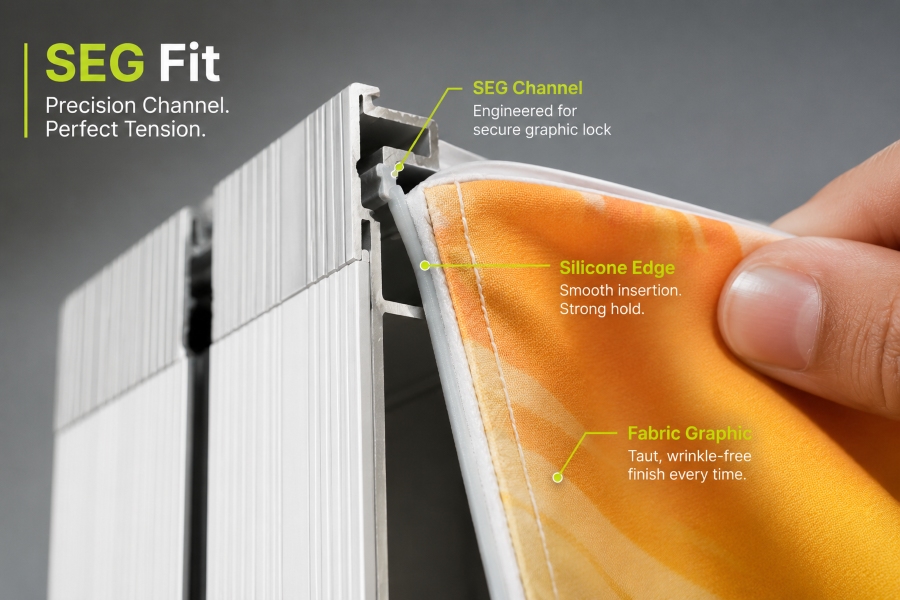
The whole system depends on the silicone-edge graphic seating cleanly into the frame channel. Poor channel geometry creates the very symptoms your customers complain about — wrinkles, snags, and graphics that loosen over time. Ask how the channel is machined, how it is toleranced, and whether the frames are pre-fitted with sample fabric before shipment. "Pre-fitting" may sound like a small courtesy; for a distributor it is a quality gate that saves costly rework later.
Verify Certifications and Documentation
For a display distributor, compliance documentation is often the difference between closing a sale and losing it to a venue's requirements. Longtime makers of SEG frame extrusions describe these systems as the structural hardware that holds tension fabric. The hardware is only commercially useful if its compliance can be proven in your market.
At minimum, require:
ISO 9001 — a baseline signal that the supplier runs a documented quality management system. Most credible aluminum manufacturers hold it, as noted across common sourcing guides for aluminum frame suppliers.
Material certificates — mill certs or material test reports for the extruded aluminum, with lot-level traceability.
Fire-rated fabric documentation — in Europe, DIN 4102-B1; in North America, NFPA 701. Venues frequently require proof for the exact fabric SKU you ship, so request test reports that match the fabric, not a generic brochure claim.
Electrical certification — CE, UL, or ETL for integrated lighting and drivers, depending on your target market.
Third-party testing — independent test reports (SGS, TÜV) that corroborate alloy, finish, or performance claims.
️ Warning: A certification name printed on a sales page is not proof. Ask for the actual test report tied to the specific SKU you are ordering. For fire-rated fabric, the report must match the exact fabric you will sell.
Assess the Supplier as a Long-Term Partner
For distributors, the real test is not the first order — it is the hundredth. Reorder consistency, lead times, and quality data determine whether you can build a dependable, profitable product line over years.
Reorder consistency and QC data
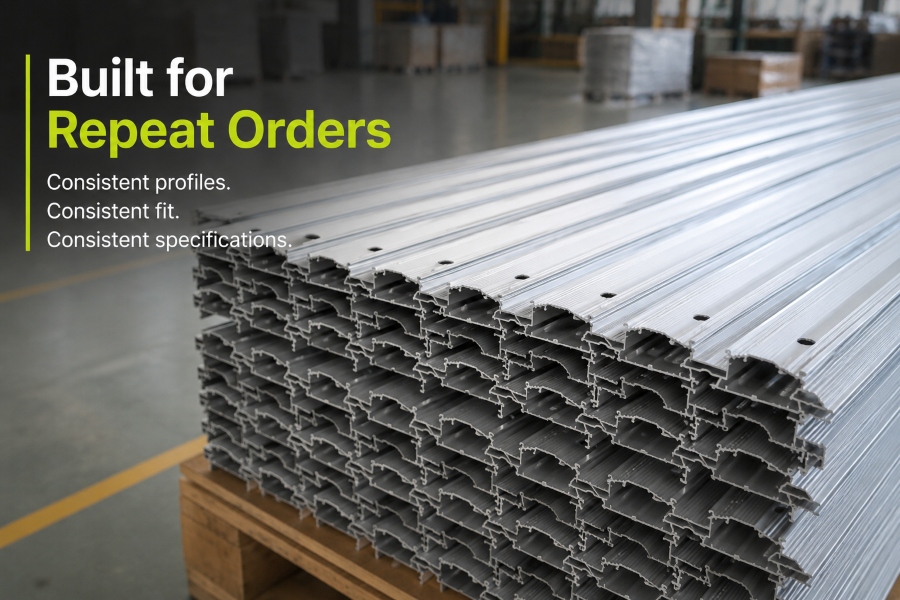
Your customers expect batch after batch of the same color, the same tension, the same fit. Ask how the supplier prevents spec drift across reorders: Do they document every order's material, finish, and tolerances? Can they show QC pass-rate data? A supplier that shares measured quality data — not just promises — gives you something defensible when a customer questions consistency.
Lead times and capacity
Distributors live and die by meeting event deadlines. Ask about standard lead times, peak-season capacity, and how they handle stock-outs. A supplier who is honest about lead times and volume constraints is safer than one who overpromises and misses your opening day.
Reliability beyond the factory
Support matters after the sale. Ask about packaging that protects profiles from transit damage, spare-parts availability (gaskets, LED drivers, corners), and how quickly they resolve specification changes or defects. Fragmented communication is a common complaint; look for a partner whose response to a quality question is a clear document, not a vague reassurance.
Red Flags and Deal-Breakers
Some signals should end the conversation:
No material documentation — a supplier who cannot name their alloy and provide traceable certificates has no way to prove consistency.
No finish or QC testing data — coating thickness, adhesion, and salt-spray results should be available.
Generic compliance claims — "fire-rated fabric" without a matching test report for your specific SKU.
Vague answers on tolerances — if they cannot articulate how they hold fit, expect wrinkles and returns.
Unclear lead times — distributors cannot plan a product line on "it depends."
No pre-fitting or sample quality check — a missing quality gate that shifts rework risk onto you.
How to Apply These Criteria
Once you have done the needs assessment and scored a shortlist of suppliers against the criteria above, the decision becomes systematic rather than gut-driven. Put each supplier into a simple scorecard: alloy/traceability, tolerance control, finish data, compliance documentation, reorder consistency, lead time reliability, and support. Weight the categories by what your product line needs — a compliance-heavy European market pushes documentation to the top; a fast-turnaround rental line pushes lead time above all else.
One way to test a supplier quickly is to ask for a sample frame plus the supporting documents for that exact unit: material certificate, finish test data, and any applicable compliance reports. If a manufacturer can deliver the sample and the paperwork, they have passed the hardest part of your evaluation.
A brief look at the landscape
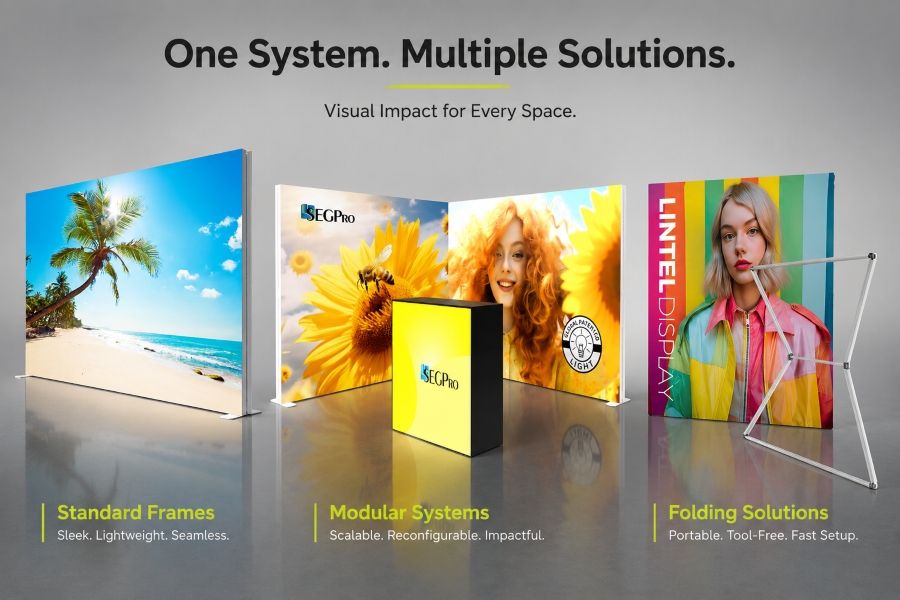
Several companies are well known in the aluminum SEG frame space, from U.S.-based manufacturers and extrusion-focused suppliers to global OEM producers such as Lintel Display. The point of this guide is not to crown any single name — it is to give you a repeatable process so that whichever manufacturer you shortlist, you are comparing them on evidence rather than marketing copy.
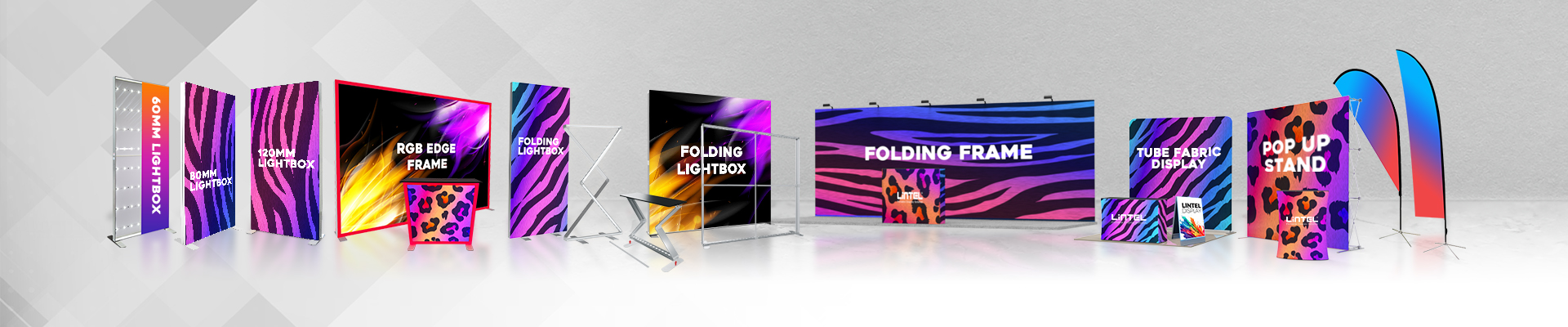
That said, when a supplier combines strong extrusion and finishing capability with a distributor-friendly service model, it is worth a closer look. Lintel Display's SEGPRO® light box line, for instance, is built on modern aluminum frames, and the company's XQUIC™ SEG Frame highlights a tool-free, folding frame design that reduces installation labor. For distributors weighing total cost of ownership, such tool-free assembly and frame reuse help cut freight and setup cost over a multi-show lifecycle — a sustainable SEG light box angle that resonates with today's event buyers.
Frequently Asked Questions
What is an aluminum SEG frame? SEG stands for silicone edge graphics. An SEG frame is an aluminum extrusion profile with a channel that accepts fabric graphics finished with a sewn-in silicone edge, holding the graphic taut for a seamless, frameless appearance.
Who makes aluminum SEG frames? The field includes U.S.-based manufacturers and extrusion suppliers, plus global OEM/ODM producers like Lintel Display, spanning both established brands and emerging specialists. The right choice depends on your need for customization, volume, compliance documentation, and lead-time reliability.
What alloy should an SEG frame use? Most quality frames use 6063-series aluminum, typically anodized, for its strength-to-weight ratio and corrosion resistance. Always ask for the specific grade and temper plus material certificates.
What documentation should I demand from a supplier? Material certificates, ISO 9001 certification, finish testing data, fire-rated fabric reports (DIN 4102-B1 or NFPA 701), electrical certification (CE/UL/ETL) for lit frames, and third-party test reports where available.
How do I confirm reorder consistency? Ask whether the manufacturer documents material, finish, and tolerances on every order and shares QC pass-rate data. Traceability across lots is the clearest sign of consistent output.


Recent News
1.One-Stop Display Manufacturing: Simplify Multi-Venue Programs with Modular SEG Systems
2026-08-252.How to Choose SEG Fabric Displays for Trade Shows and Backlit Signs
2026-08-133.How Global Exhibition Companies Reduce Shipping and Storage Costs with Modular SEG Light Box Systems
2026-07-094.How a Sustainable SEG Light Box Company Helps You Save Cost and Waste
2026-06-16