


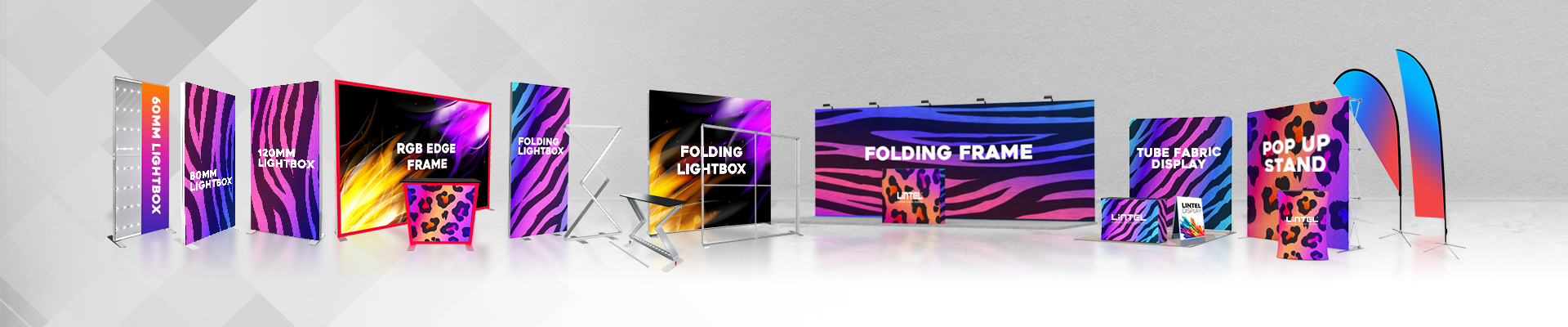
 Nov 06, 2026|
 View:11
What Makes a Reliable Tension Fabric Display Manufacturer?
A supplier who quotes 15 percent less rarely fails at the sample stage. The sample is usually good. The problem arrives in the third show season, when joints have loosened, graphics sag, and the connector you need is no longer produced.
Reliability is not a promise made in an email. It is a set of drawings, records and design rights you can inspect before you commit.
Quick answer: what makes a manufacturer reliable?
A reliable tension fabric display manufacturer can prove five things: it owns the structure design and the tooling behind it, it keeps inspection records by batch, its certificates name the models they cover, its specification sheets are versioned, and it supplies spare parts after delivery. Price, catalogue size and sample quality are all easier to stage than these five.
Key takeaways
Ask who owns the extrusion die and the folding mechanism; a reseller cannot answer with a drawing.
Ask for inspection records from the last three batches, not one annual figure.
Ask for the certificate number, issuing body and covered model list.
Ask for a parts list with part numbers before ordering, not after a failure.
What separates a real manufacturer from a trading company?
The difference is what they can hand over, not what they claim. A factory sends drawings, die numbers, an audit date and a live video walk-through. A trading company sends a catalogue and a quotation, and both look convincing as a PDF.
The fastest test is a detail question: which section of a 32mm tube carries the internal bungee cord, and how is it replaced when tension drops? A manufacturer answers in one sentence, because someone in the building does it weekly. A reseller forwards the question and returns with a paraphrase.
Can the factory show its own structure design and tooling?
Structure ownership decides three things: how fast a change can be made, whether parts exist in year five, and whether tolerances hold between batches. Own the die and you control wall thickness and joint fit. Buy standard tube on the open market and fit drifts with each purchase.
Repeated assembly wears the anodized layer inside the joint. A thin film fails early, the connection loosens, and the frame stops holding tension — a failure buyers describe as "the frame feels tired". Technical references on aluminum alloys and anodized finishes explain why film thickness, not tube diameter, sets service life.
Lintel has built display frames since 1998 and holds over 50 patents, with folding mechanisms still at the patent-pending stage. Ask any supplier for wall thickness tolerance and film specification in writing.
What quality evidence should you actually ask for?
Ask for records, not adjectives. Evidence sits in three layers, and a serious factory produces all three without preparing a special document.
Incoming inspection covers wall thickness, fabric weight and colour against the approved sample. In-line checks cover cut length, joint fit and squareness. Final inspection covers AQL sampling, a power-on test for light boxes and a full trial assembly for booth kits.
A single annual pass rate tells you little. Ask how it is recorded per batch, and what happens to a failed one. Lintel publishes a 99.47 percent factory pass rate; treat that as a company figure and ask what method sits behind it.
Which certifications matter, and what do they actually cover?
Two categories answer different questions. Management system certificates describe process; product certificates describe compliance. Confusing them is the most common screening mistake.
ISO 9001 says a quality system exists. It does not say a specific light box is safe. For most display hardware, CE marking is a manufacturer's declaration, so ask for the Declaration of Conformity and the test reports behind it. The official guidance on what CE marking does and does not certify is worth reading before accepting a logo on a catalogue page.
RoHS, FCC, RCM and UL cover different markets and risks. Request four items: certificate number, issuing body, validity date and covered model list. If that list reads "all products", the certificate is being used loosely.
Why does documentation quality predict delivery quality?
A specification sheet is the input to production. If it is vague, the factory fills the gap with an assumption, and the assumption ships.
Three signals are easy to check: one sheet per SKU rather than one catalogue for the range; configuration split into Standard, Optional and Custom; a version number and date, so a changed dimension retires the old sheet.
Ask whether the supplier grades its own data by source — measured, drawing-based, estimated or pending. One that marks a number as pending knows the difference between measured and guessed.
How do packing data and loading plans affect landed cost?
Display hardware is bulky freight, and volumetric weight decides the invoice. Get three numbers before comparing prices: carton dimensions with gross weight, units per carton, and units per 40HQ.
A few centimetres of carton length can push a shipment into a higher tier. On a 20ft frame, carton length is set by the longest tube section, so how the frame splits matters as much as the frame size. Ask whether sections can be divided to shorten the carton, and what that adds to assembly time.
What after-sales structure keeps a display system usable for years?
A frame is a capital item, not a consumable. Its real cost settles in year three, when the graphic changes and a connector breaks. Exhibitors return to the same shows year after year, which is why industry data on exhibition cycles matters more to hardware buyers than it first appears.
Request four things at quotation stage: a parts list with part numbers, the graphic replacement process and lead time, the parts that fail first — connectors, bungee cords, base plates, zippers — and what happens when a model is discontinued.
The question most buyers forget: will this model still be produced in five years, and if it is replaced, will a new graphic fit the old frame? A manufacturer with its own tooling can answer. A reseller has to ask someone else.
| What to check | Weak answer | Strong answer |
|---|---|---|
| Manufacturing role | We work with several factories. | We own the assembly line; here is a live audit slot. |
| Tooling and structure | Same as the market standard. | Our own die and drawing, tolerance stated in writing. |
| Quality records | Our quality is 100 percent guaranteed. | AQL sampling, batch records, failed-batch disposition. |
| Certification scope | We have CE. | Certificate number, issuer, model list, test report. |
| Specification documents | Our catalogue is available. | One versioned sheet per SKU, Standard and Optional marked. |
| Packing and loading | Carton size on request. | Carton L×W×H, gross weight, units per 40HQ. |
| Spare parts | We can send parts if needed. | Parts list with part numbers and lead times. |
Use this table as a written questionnaire for your next supplier conversation.
Send us your checklist
We will answer it point by point, including the parts we do not do in-house.
Get a Quote
The bottom line
Reliability is a process property, not a promise. A supplier who can produce a drawing, a batch record, a certificate naming its models and a parts list is telling you what a discount cannot: that the system will still work when the novelty of the price has worn off.
FAQ
How do I verify a tension fabric display manufacturer before ordering?
Start with documents, not a factory visit: a production drawing, a batch inspection record, a certificate with a model list and a spare parts list. A supplier who produces all four has a system; one who cannot is usually a reseller.
What is the difference between a trading company and a manufacturer?
A manufacturer owns the tooling and the assembly line. Test it with a detail question about how a part is made or replaced. A reseller can forward it, but cannot change the answer when your specification changes.
Which certifications should a display manufacturer hold?
A management system certificate such as ISO 9001, plus product compliance for your markets: CE and RoHS for Europe, FCC for the United States, RCM for Australia. Ask which models each one covers.
Can I request a pre-production sample?
Yes. A sample confirms finish, fabric and hardware at one point in time, but it does not confirm batch consistency. Pair it with inspection records from the last three runs.
What should a display specification sheet contain?
Model, dimensions, tube diameter and wall thickness, graphic attachment method, lighting configuration, packing size and weight, and a clear split between standard, optional and custom items. Add a version number and date.
Company figures cited here, including facility size, production lines, patent count and pass rate, are published by the manufacturer and should be verified independently during supplier assessment.