


Straight Tension Fabric Backdrop: How to Choose 8ft vs 10ft vs 20ft
 Nov 09, 2026|
 View:10
A backdrop 20cm too wide will not fit between two side walls. One 60cm too narrow leaves bare wall at both ends, and visitors see that gap before they see your brand. Width is the first decision in a backdrop purchase, yet most buyers settle it last.
This guide compares the three standard widths of a straight tension fabric backdrop — 8ft, 10ft and 20ft — using the published specifications of the LT-24Q1 of Lintel Display.
Quick answer: Which Backdrop Width Should You Choose?
Choose an 8ft tension fabric backdrop for compact display areas or a centered graphic within a larger booth. A 10ft backdrop is a common option for standard 10 × 10ft exhibition spaces, while a 20ft backdrop suits wider display walls and larger booth layouts.
Before ordering, confirm the assembled frame dimensions, usable wall clearance, and base footprint. Nominal booth sizes and printed graphic dimensions do not always represent the actual installation space.
Key takeaways
Height is 244cm on all three widths; only width changes, so one number sets the visual weight of the wall.
Graphic size is smaller than the name: 8ft = 245cm, 10ft = 305cm, 20ft = 611cm. Plan against graphic size, not the label.
The 20ft carton jumps to 35 x 17 x 105cm, which can push a shipment into a higher freight tier.
A frame takes a new graphic every season, but never a wider one.
What actually determines the right width?
Measure the wall, not the floor. A 10 x 10 ft shell scheme gives 305cm between side panels — exactly the 10ft graphic, a flush fit. Deduct 5–10cm per side at a corner, and the 8ft frame becomes safer.
Check the ratio and the sight line. At 244cm high, 8ft is close to square and suits a centred logo; 10ft sits at about 1.25:1, the most common exhibition proportion; 20ft reaches 2.5:1 and reads as a band. A wide wall wins from the aisle and loses inside the booth, where a visitor two metres away cannot see both ends. Long aisle traffic justifies 20ft; a 3 x 3m stand does not.
What is an 8ft backdrop best for?
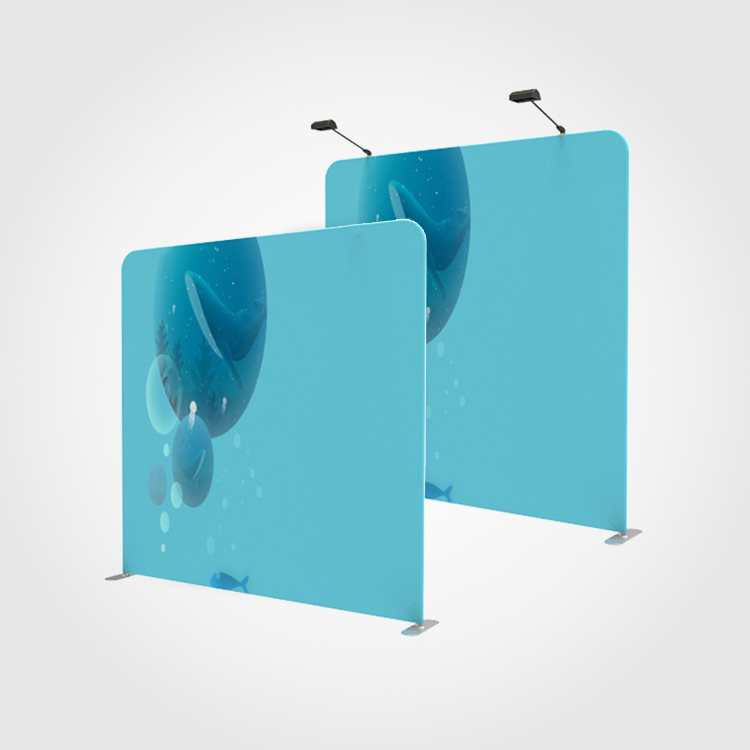
At 245 x 244cm the 8ft frame is almost square, and that is its advantage. It fits 8 x 8 ft booths with room to spare, screens a storage area, and creates a clean photo point without dominating a small stand. It also packs into the shortest carton of the three, at 92cm. The limit is coverage: in a 10 x 10 ft booth it leaves roughly 30cm of bare wall at each end.
Why is 10ft the default for 10 x 10 ft booths?
Because 305cm is the wall. The graphic runs the full width of the stand, the side walls close against the frame ends, and the result looks built rather than placed. It is also the easiest size to draw: one panel, one width, no filler pieces. For contractors this is the workhorse — a single 105cm carton and straight tube sections rather than a folding mechanism.
When does a 20ft backdrop make sense?
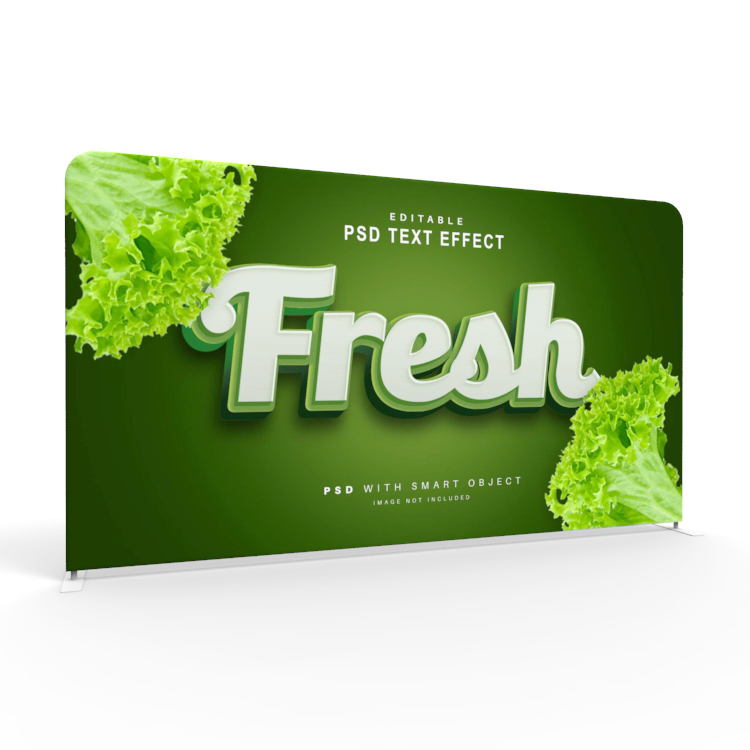
The 20ft frame carries a 611cm graphic and suits 10 x 20 ft booths, double-fronted stands and long aisle-facing walls. It is the only one of the three that holds a full-width statement without repeating a pattern, and at 2.5:1 it leaves room for a sequence — a product line, a timeline, a set of locations.
Can one person install a 20ft backdrop?
In practice, no. Lintel does not publish a single-person assembly time for this frame, because crew size and floor conditions change it more than width does. At 6.11m the frame is joined from multiple tube sections, then the sleeve is pulled across the full width and zipped closed. For a 20ft backdrop, a two-person installation team is recommended to help position the frame and fit the fabric evenly. Actual assembly time depends on the installation conditions and crew experience.
How is the frame built, and how does the graphic attach?
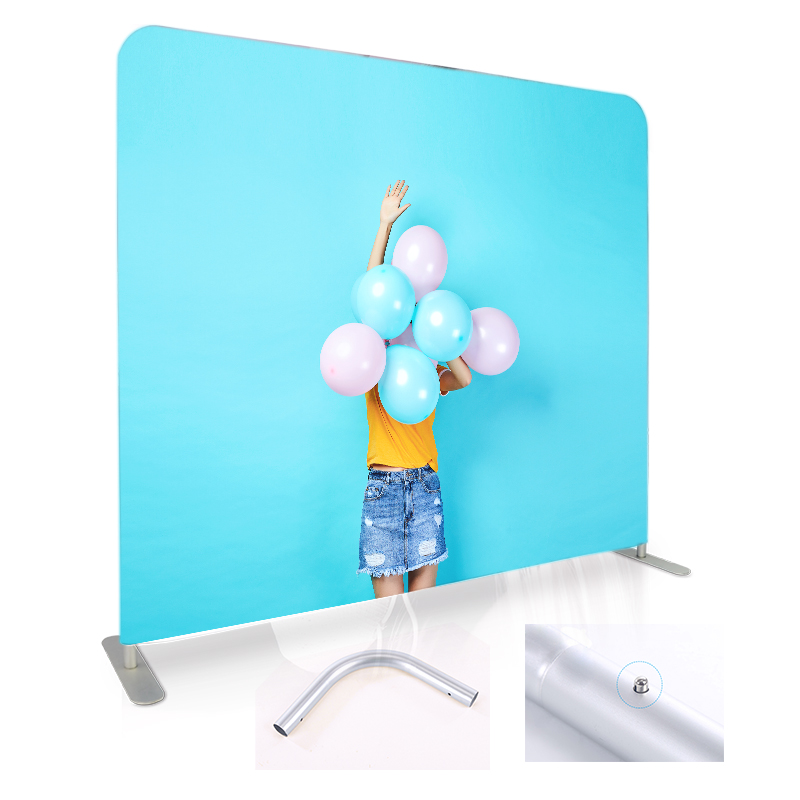
All three widths share one construction: 32mm anodized aluminum tube, snap-pin joints, and an internal bungee cord. The cord is what buyers underestimate — it keeps sections in sequence, so the frame goes together in order instead of being sorted on the floor. Aluminum base plates form the footprint; they are not floor anchors.
The graphic is a pillowcase tension fabric: a sewn sleeve that slides over the assembled frame and closes with a zipper. Tension comes from the sleeve being cut slightly smaller than the frame, not from stretching it, so a 10ft sleeve will not tension on an 8ft frame.
What does packing size do to freight?
This part never appears on a booth drawing. The 8ft and 10ft frames share a 23 x 15cm cross-section and differ only in length. The 20ft frame jumps to 35 x 17 x 105cm, so volumetric weight grows faster than the width ratio suggests.
| Frame | Graphic | Packing | Typical use | Watch out for |
|---|---|---|---|---|
| 8 x 8 ft | 245 x 244 cm | 23 x 15 x 92 cm | 8 x 8 ft booths, corner walls | Gap at each end of a 10 x 10 ft wall |
| 10 x 8 ft | 305 x 244 cm | 23 x 15 x 105 cm | 10 x 10 ft booths, standard wall | Flush fit leaves no margin for uneven panels |
| 20 x 8 ft | 611 x 244 cm | 35 x 17 x 105 cm | 10 x 20 ft booths, islands | Higher freight tier; two-person build |
Specifications above are for the LT-24Q1 straight frame with pillowcase graphics. Other heights and custom widths are available on request.
Not sure which width your booth needs?
Send us your booth drawing or the venue's wall dimensions. We will confirm the graphic size, packing volume and freight implication before you commit.
Get a Quote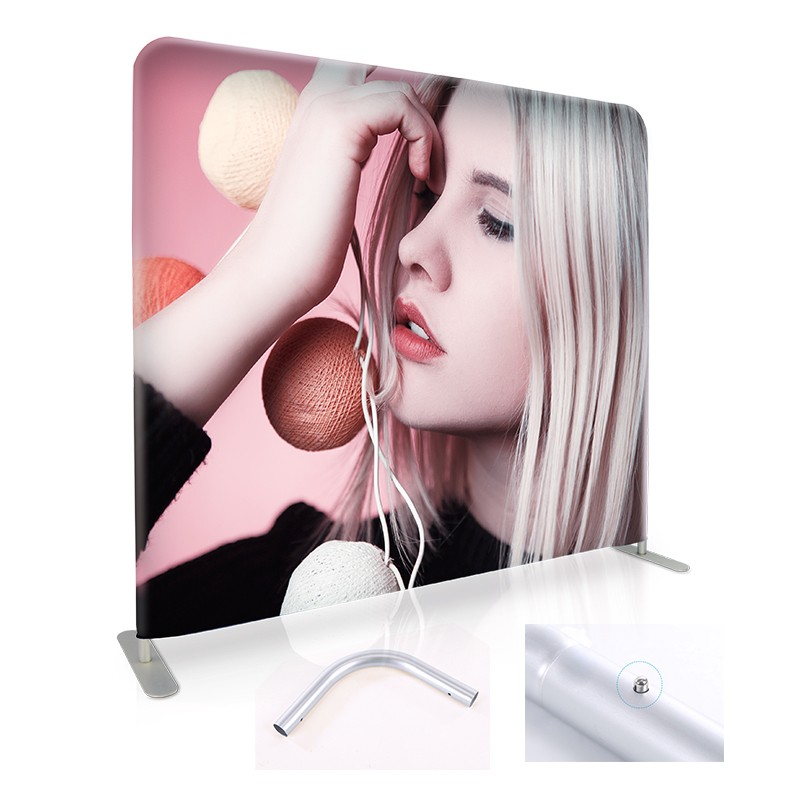
For projects requiring a reception or product demonstration area, the LT-09B8 Collapsible Counter is an additional display option to consider.
Which size should you choose?
Wall 305cm or wider, both ends must look finished? Take the 10ft. It disappears into the stand.
Wall shorter or interrupted, or want visible margin? Take the 8ft. Its square ratio suits a centred logo.
Stand 10 x 20 ft, island, or long aisle traffic? Take the 20ft, and plan for two people and a bigger carton.
Width is not a matter of ambition. It is a measurement, a ratio and a freight calculation — once those three agree, the choice is usually obvious.
FAQ
Is a 10ft backdrop big enough for a 10 x 10 ft booth?
Yes. The 305cm graphic spans the full back wall and the side walls sit flush against the frame ends. If panels are uneven or you want margin on both sides, the 8ft frame is more forgiving.
How long does assembly take?
Lintel does not publish a single assembly time for this frame, because crew size and floor conditions matter more than width. Expect the 20ft frame to need at least two people.
Can the frame be reused with a new graphic?
Yes. The frames are made for repeated event use, and replacement graphics can be ordered to the same dimensions. The frame is the fixed asset; the graphic is what changes.
Do these backdrops work outdoors?
Outdoor use is possible in calm weather, but this frame is designed for indoor use. Suitability depends on wind exposure, anchoring and site conditions; a tube frame with base plates is not a wind-rated structure.
For context on exhibition space and stand design, the global exhibition industry association publishes annual venue and visitor data. For the material side, the aluminum industry technical library covers alloys and anodized finishes in more depth than a product page can.
All dimensions refer to the Lintel LT-24Q1 straight tension fabric backdrop. Custom sizes, other tube diameters and curved configurations are available in the wider EZ Tube range; confirm specifications before quotation.



Recent News
1.What Importers Should Check Before Buying an EZ Tube Frame
2026-10-282.How do EZ Tube backdrop compare to traditional signage
2026-05-133.New Tube Frame Light Box for Retail
2025-04-034.Create Impactful Displays with Lintel Display EZ Tube Fabric Frames
2024-06-145.Lintel New upgraded EZ and Protable Tension Fabric Tube Booth
2022-05-25