


Ultimate Guide to Modular Trade Show Booths
 Feb 03, 2026|
 View:1154
If your exhibit program feels more expensive, harder to staff, and slower to adapt every season, you’re not alone. Space rates rise, labor rules change, and brand teams need fresh looks at a faster clip. That’s why interest in modular trade show booths has surged: systems you can assemble tool‑free, reconfigure across footprints, and refresh with new graphics without starting from scratch. This guide explains when modular makes sense, how to model ROI over 3–5 show cycles, and what to ask vendors so you can reduce total cost of ownership (TCO), meet sustainability expectations, and move faster—without sacrificing brand presence.
What “modular” really means on the show floor
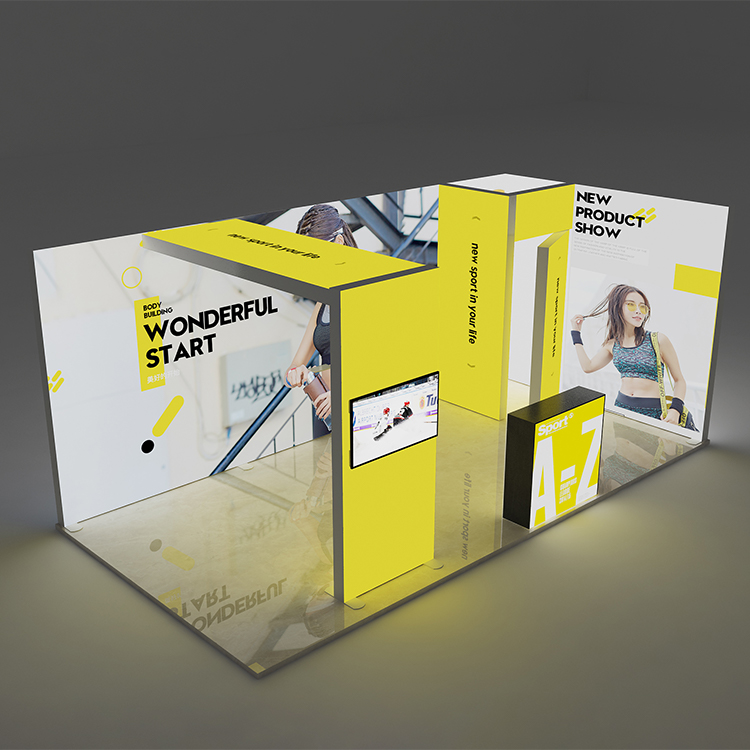
Modular trade show booths use repeatable components—most often aluminum extrusions with SEG (silicone‑edge graphic) fabric panels, light box modules, towers, and counters—that connect without tools or with simple hand turns. Think of it like building blocks: frames, connectors, and accessories you assemble into a 10×10 today, then reconfigure into a 10×20 or peninsula tomorrow. Because the structure is standardized, the “newness” comes from layout changes and fresh graphics rather than new carpentry.
Common elements you’ll see on-site:
SEG fabric walls and light boxes that pack flat, weigh less than rigid panels, and deliver crisp print quality.
Tool‑free connectors and foldable frames that speed installation and reduce install & dismantle (I&D) labor.
Accessory channels for shelves, monitors, headers, and backlit logos that can move with your layout.
In short, modular systems trade one‑off construction for reusable parts, which is the foundation for the TCO, sustainability, and agility gains you’re after.

Rent, buy, or go modular? A frequency-based framework
Here’s the rule of thumb many program managers use: if you attend one or two shows a year, rentals often make financial sense because you avoid storage and upkeep and can test different looks. If you exhibit three or more times a year—especially at consistent sizes—ownership (ideally in a modular format) tends to pay back through reuse and lower per‑show production costs. That pattern is echoed in independent guidance from major providers. For example, GES outlines when owned/custom vs. rental is favorable, emphasizing frequency and consistency as the key drivers of ROI in its exhibitor resources on custom or rental choices. See the discussion in the 2024–2026 GES resources under the article on choosing between custom or rental booths: GES’s comparison of custom vs. rental.
Rental specialists share similar advice: rentals are excellent for first‑timers, market tests, or programs with volatile sizes or themes; higher‑frequency exhibitors usually benefit from ownership because costs amortize across cycles. That perspective is laid out in Featherlite’s 2025–2026 rental guide: Featherlite’s guide to rental booths—when, why, and how.
Two caveats before we go further:
If your footprint changes wildly show to show, modular ownership still works, but choose systems designed for rapid reconfiguration, not fixed-format kits.
If capital is tight, start with a rental to validate your program, then convert to modular ownership once your schedule stabilizes.
TCO and ROI across 3–5 show cycles: how to model it (without guesswork)
To compare options, build a simple multi‑cycle model. You’re balancing upfront capital (design/build or kit purchase) against per‑show operating costs (shipping, drayage, I&D labor, storage, graphics refresh). Use realistic price bands and category weights from credible industry sources and be transparent about assumptions.
A few anchors:
Industry reporting shows design/construction is a material slice of total budgets, while services, travel, and shipping make up the rest. Exhibitor Magazine’s survey-based budgeting analysis offers practical category guidance that you can adapt to your program. See the survey summary in Exhibitor Magazine’s budgeting analysis.
Public pricing guides indicate wide ranges: portable/modular kits from roughly the low thousands to tens of thousands, while custom island exhibits often begin around $50,000 and escalate quickly. For examples and live ranges, review DisplayStop’s pricing guide with examples.
Here’s a simplified way to compare over five shows. Replace numbers with your quotes and historicals.
Input | Rental (per show) | Modular Ownership (one-time + per show) |
|---|---|---|
Upfront design/build or kit | $0 | $18,000 |
Shipping + drayage | $4,000 | $2,800 |
I&D labor | $3,000 | $1,800 |
Storage (owned assets) | $0 | $500 |
Graphics refresh cadence | $1,000 | $600 |
Illustrative cumulative totals across 5 shows:
Rental: 5 × ($4,000 + $3,000 + $1,000) = $40,000
Modular ownership: $18,000 + 5 × ($2,800 + $1,800 + $600 + $500) = $18,000 + $28,500 = $46,500
In this conservative scenario, rental appears cheaper at five cycles. But tweak two variables—reduce drayage and I&D through lighter, tool‑free hardware and pack‑efficient cases—and ownership can cross over earlier. For example, if modular shipping/drayage drops to $2,200 and I&D to $1,400, five‑show ownership becomes $18,000 + 5 × ($2,200 + $1,400 + $600 + $500) = $18,000 + $24,500 = $42,500, edging out rental.
The key insight: the ROI inflection depends on frequency, labor rules, weight/volume, and graphics strategy. Model your real numbers. Then consider reconfiguration value—being able to cover multiple footprints without buying or renting again—which isn’t always captured in pure dollars but shows up as fewer rush fees and more calendar flexibility.
Agility in practice: fast setup, reconfiguration, and graphic refreshes
If your brand pivots quickly, you need a booth that can pivot with it. Tool‑free systems let small teams assemble walls and light boxes without specialized labor. SEG fabric graphics roll or fold for compact transport, and swapping messages is a matter of minutes rather than a rebuild.
Practical micro‑example (disclosed): On some programs, we’ve used a foldable, tool‑free SEG frame system to move from a 10×10 meeting booth to a 10×20 product‑demo lane by adding a light box and a tower, reusing the same base frames and simply changing two graphics. Disclosure: Lintel Display is our product. To see how a tool‑free, foldable frame connects and pivots between layouts, review this mechanism example: XQUIC System—tool‑free modular SEG frames.

A few operational tips that keep agility real on-site:
Standardize on a frame depth and connector set so parts interchange cleanly across footprints.
Pre‑label frames and cables; pack by “first up” order to cut I&D time.
Plan a graphics lifecycle (e.g., quarterly campaigns) and keep a spare message set on hand for last‑minute pivots.
Logistics and operations: shipping, drayage, storage, compliance
Modular hardware typically packs smaller and weighs less than wood builds, reducing freight class and drayage. Light boxes add power draws, so create a cable map and power plan in advance. For storage, soft rolling cases work for small kits; larger programs benefit from custom crates with foam cavities to preserve finishes and speed inbound QC.
On compliance, assume you’ll need layout drawings with dimensions and heights, material specifications (including fabric fire ratings), and electrical plans. Large shows may require additional safety documentation and on‑site inspections—especially for dynamic displays. The industry’s big shows publish detailed guidance; for example, the International Association of Amusement Parks and Attractions outlines exhibitor requirements for booth design, drawings, and safety documentation in its 2024–2025 materials: see IAAPA’s booth design and display guidelines.
Sustainability and ESG: what venues and buyers now expect
Procurement teams increasingly weigh ESG alongside price and schedule. Event platforms also report that green practices influence sourcing outcomes: Cvent’s hospitality analysis describes how sustainability has become a differentiator for venues and suppliers in recent years—helping planners meet internal goals while managing cost and logistics. See the discussion in Cvent’s “Why green is the new gold”.
Venue policies make expectations concrete. ExCeL London’s public sustainability documents describe zero‑to‑landfill commitments, higher recycling targets, and services for waste sorting and carbon measurement that exhibitors can opt into or may be required to address depending on their stand type. For reference, review ExCeL London’s 2023–24 Sustainability Report PDF.
A practical ESG checklist for modular trade show booths:
Materials: Prefer recyclable aluminum, low‑VOC inks, and fabrics with documented fire ratings (e.g., DIN 4102 B1; request NFPA 701 or local equivalents where required).
Energy: Specify LED light boxes, schedule power‑down outside show hours, and use certified power supplies.
Waste: Plan for graphics reuse and end‑of‑life recycling; avoid single‑use décor; pre‑sort packaging for load‑out.
Documentation: Maintain certificates (fire ratings, electrical marks), material specs, and layout drawings for venue review.
Logistics: Right‑size cases/crates to minimize drayage; consolidate shipments where possible.

Choosing a vendor: what to ask before you sign
Selecting a modular partner is less about a glossy render and more about the system behind it. Use these questions to separate marketing from reality:
Compatibility and lifespan: Are components cross‑compatible across depths and generations? What is the expected hardware lifespan and spare‑parts availability?
Assembly & manuals: Is the system genuinely tool‑free? Can they provide step‑by‑step manuals and time estimates per footprint?
Certifications & safety: Do fabrics carry recognized fire ratings (B1, NFPA 701 where applicable)? Are light boxes UL/CE marked with cable plans?
Graphics throughput: What is the lead time for reprints? Can the vendor support rush cycles before tier‑one shows?
Capacity & QA: What is the manufacturing capacity, warranty, and QA process for frames and finishes?
If you operate a multi‑show program across sizes (10×10, 10×20, 20×20), ask for a reconfiguration blueprint showing which frames, connectors, and accessories carry across all footprints. That blueprint becomes your bill of materials and packing plan.
You've defined the criteria. Lintel meets them.

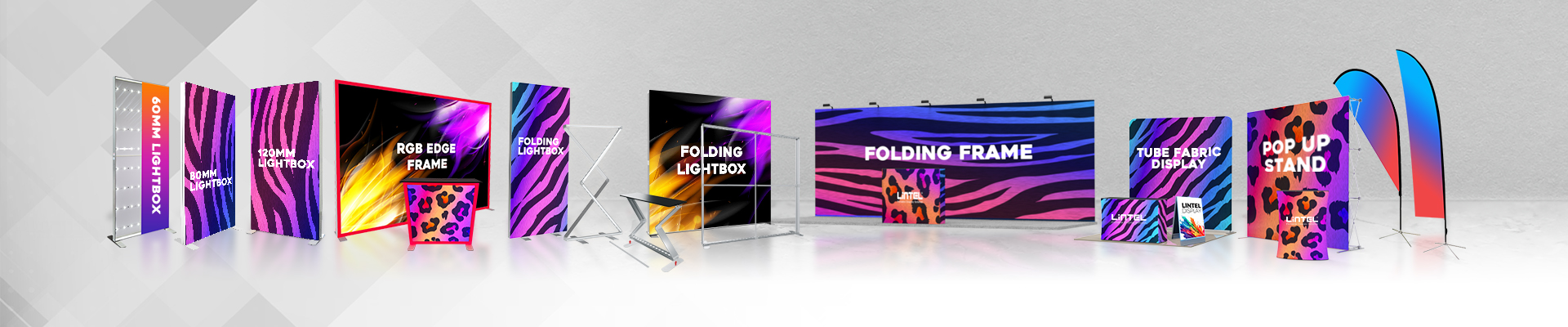
For 20+ years, we've built robust systems, not just marketing. Our RGB LED Edge Frames and SEGPRO ecosystem offer true cross-compatibility, certified safety (CE/UL, B1 fabrics), and genuine tool-free assembly.

We provide clear manuals, reliable graphics throughput with rush options, and scalable ISO-certified manufacturing.
Move from questions to solutions.
Contact us for detailed technical documentation, certification files, or to schedule a consultation.
Email: marketing@lintel.com.cn
Let's discuss your project's specific needs.
FAQ: quick answers for busy teams
Q: Are modular trade show booths only for small footprints?
A: No. While many start with 10×10 or 10×20 inline kits, modular systems scale to islands with light boxes, towers, and meeting rooms. The limit is usually budget and logistics, not the system itself.

Q: How often should we refresh graphics?
A: Many teams align graphics to campaigns (quarterly or semi‑annual). Fabric prints are cost‑effective and easy to swap, so plan a cadence that fits your marketing calendar and storage capacity.
Q: Do modular systems pass fire inspections?
A: Yes—provided you specify compliant materials and keep certificates on hand. Ask for fabric fire ratings (e.g., DIN 4102 B1 or NFPA 701 as required) and electrical certifications for powered elements.
Q: Can modular really reduce labor?
A: Tool‑free frames, lighter materials, and better packing can reduce I&D hours. The amount varies by venue and union rules; model it with your historical invoices and adjust assumptions over time.
Wrapping up and next steps
Here's the deal: if you exhibit three or more times a year, modular trade show booths deserve a hard look. The combination of reusable hardware, lighter logistics, and reconfigurable layouts can lower multi‑cycle TCO, help you meet ESG expectations, and give your brand the agility to pivot between shows. Start by modeling your next 3–5 shows, gather quotes for rental and modular ownership, and pressure‑test assumptions around shipping, drayage, and I&D. Then request a reconfiguration blueprint from your shortlisted vendors and a sample setup to validate tool‑free claims.
If you'd like a neutral walkthrough of a tool‑free SEG framework and what a reconfiguration plan looks like in practice, review the mechanism example linked above and bring those questions to your next vendor call. You’ll make a better decision—and you’ll feel it in both the budget and the booth.